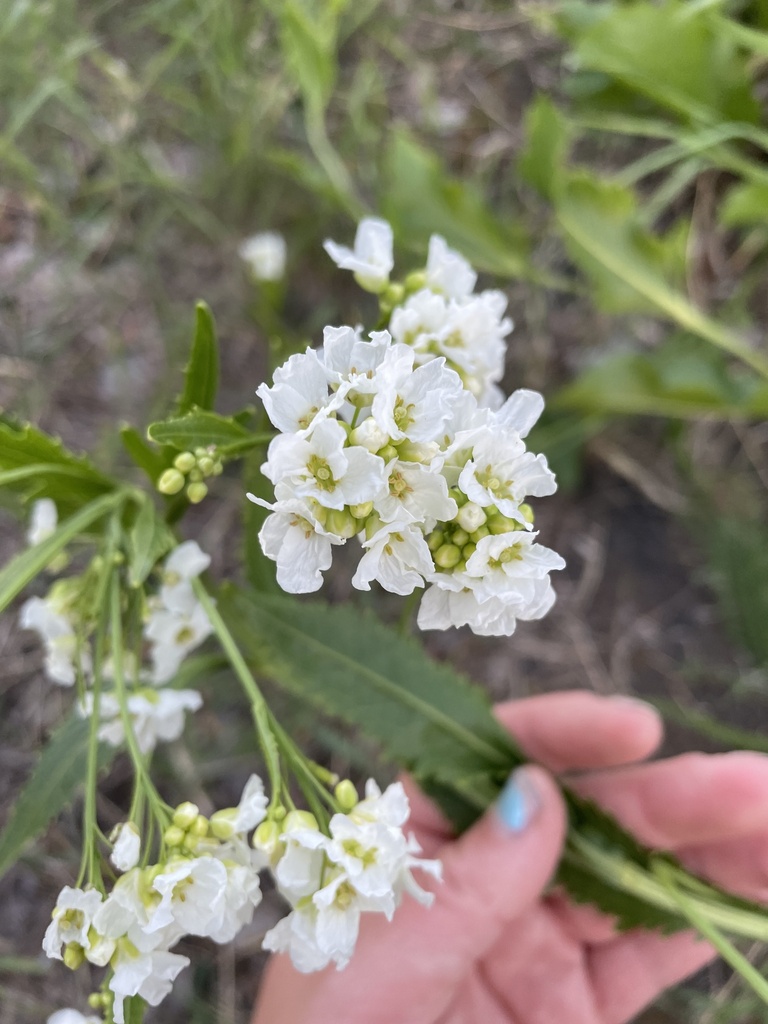
Overview
Horseradish is the fiery root of the mustard family, best known as the condiment that clears your head in one bite. Herbalists value that same heat: it is a stimulant, meaning it warms and gets sluggish circulation, digestion and stuck mucus moving, with a special affinity for the airways, the digestive tract and the urinary tract.
Plant family
Brassicaceae (Cruciferae)
Parts used
Fresh root.
Actions
Stimulant · Rubefacient · Expectorant · Antimicrobial · Diuretic · Diaphoretic · Digestive · Antispasmodic · Antiscorbutic · Stomachic
Affinities
Lungs · Sinuses · Urinary tract
Body systems
Respiratory · Urinary · Digestive · Musculoskeletal
Taste profile
Pungent, hot and biting, with a lingering sharpness.
Energetics
Hot and drying.
Tissue states
Cold · Damp
Traditional use
Traditionally, horseradish has been taken to wake up a poor appetite and sluggish digestion, ease gas, colic and constipation, and support a congested liver and gallbladder; for the chest and head, through coughs, bronchitis, asthma, hay fever, hoarseness, sore throat and sinus congestion; as a diuretic for fluid retention and for bladder and urinary infections; for rheumatism, gout, sciatica and neuralgia; as a warming circulatory tonic for chilblains; against intestinal worms; and, being very high in vitamin C, against scurvy. On the skin, the scraped fresh root or an ointment was applied to aching joints, nerve pain and chilblains, and a milk infusion of sliced root was used as a skin wash. It is also a classic ingredient in fire cider.
Current use
Germany's Commission E approved horseradish root for catarrh (thick mucus congestion) of the airways, as supportive treatment for urinary tract infections, and externally for minor muscle aches. A horseradish-plus-nasturtium combination has been studied in Germany for the urinary tract and upper airways, because the mustard oils are antimicrobial. Laboratory research is exploring several other areas: water extracts of the root protected human white blood cells from oxidative damage (antioxidant); isothiocyanates from the root were strongly active against bacteria and yeast that live in the mouth, including those linked to tooth decay; a root extract calmed inflammatory signals in human immune cells, and some root compounds slowed tumor cell growth in the dish (all test-tube work, not proof of benefit in people). The same isothiocyanates kill several stored-grain insects, and horseradish peroxidase, an enzyme the root is rich in, is a workhorse of medical research and diagnostics and is being studied for breaking down pollutants such as BPA, reducing manure odors and treating wastewater.
In the kitchen, it is a low-calorie, flavor-packed condiment: a little stirred into eggs, potato salad, sauces, meatloaf or sour cream goes a long way, and it is sometimes added to pickles to keep them crisp. Unlike hot peppers it doesn't usually burn the skin; its heat is a vapor that rises into the nose.
Preparation
Only the root is used, ideally fresh. Its heat does not exist in the whole root: two compounds, sinigrin and the enzyme myrosinase, are stored in separate cells, and only when the root is grated, crushed or scraped do they meet (in the presence of water) and form allyl isothiocyanate, the pungent mustard oil. That oil is volatile, so grated horseradish loses strength quickly in the air and is largely destroyed by boiling; prepare it just before use, and steep it rather than cook it. Vinegar preserves it well, and water and alcohol extract most constituents. Common forms: freshly grated root in food; fresh juice; an infusion or a honey syrup (grated root steeped, covered, in hot water for a couple of hours, strained and sweetened, taken by the teaspoon) for coughs, congestion and urinary support; a vinegar preparation (scraped root steeped in apple cider vinegar for about a day, strained, with some glycerin added, taken diluted in water before meals) traditionally for fluid balance; tincture or fluid extract for digestion, rheumatism and sciatica, or as a diaphoretic (to bring on a sweat). Externally: a thin poultice or ointment over a cloth for neuralgia, rheumatism, gout and chilblains, kept short because the fresh root can blister. It pairs with ginger as a corrective herb in stimulant formulas.
Dosage guidance
Culinary amounts are the safest way to enjoy it. As general guidance only: Commission E lists an average daily dose of about 20 g of fresh root (or equivalent) for internal use, and external preparations with no more than 2% mustard oils; syrups are typically taken a teaspoon or two several times a day. Stay within these amounts, since larger doses irritate. Please start small; a little goes a long way.
Cautions & contraindications
Normal food use is fine for most people, but please avoid medicinal amounts during pregnancy and breastfeeding (its glucosinolates can pass into breast milk), in children under four, and if you have stomach or intestinal ulcers, gastritis, inflammatory bowel conditions, or kidney inflammation or other kidney disorders (its strong diuretic and irritant action can aggravate them). Too much can cause stomach and gut irritation, vomiting, diarrhea, night sweats, and irritation of mucous membranes and the urinary tract. The fresh root and its fumes irritate the eyes, nose and skin, and prolonged skin contact can inflame and blister; dried root is milder. People with an underactive thyroid or taking thyroid medication should keep to food amounts and talk with their practitioner. Horseradish essential oil is not for aromatherapy use at all.
Why: allyl isothiocyanate, the mustard oil formed when the root is crushed, switches on the body's pain-and-heat sensors (the TRPA1 receptor) and directly irritates skin and mucous membranes, which is why it stings, blisters and can inflame the stomach, gut and kidneys in large amounts. Breakdown products of glucosinolates, including thiocyanate, can compete with iodide for the pump that carries iodine into the thyroid (the sodium-iodide symporter) and may slow thyroid hormone production, which is why horseradish may interfere with hypothyroid therapy in medicinal amounts; at normal food intake this effect is considered small.
Evidence notes
From Winter's HERB303 eTextbook (horseradish monograph) and M6 notes, plus Commission E, Drugs.com, Michigan Medicine, PFAF and peer-reviewed thyroid/TRPA1 sources. Textbook paraphrased and condensed (no duplication); homeopathic and 'alternative stimulants' lists deliberately omitted.