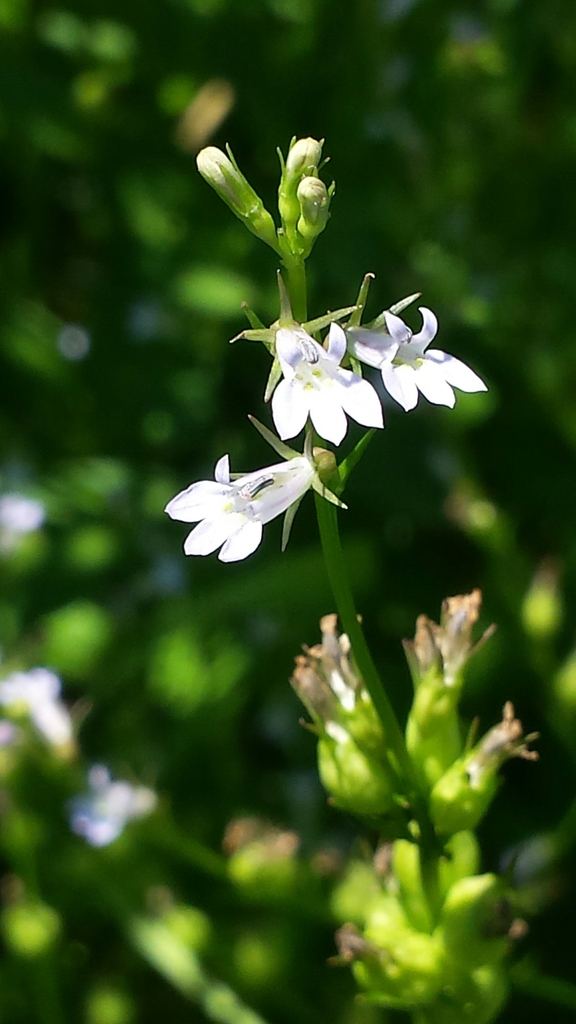
Overview
Lobelia, also called Indian tobacco or pukeweed, is a small North American wildflower with inflated seed pods and a powerful reputation. It was once a mainstay of American physiomedical herbalism for tight, wheezy chests and spasms. It has a low therapeutic margin, meaning the gap between a helpful dose and a harmful one is small, so it belongs only in skilled hands.
Plant family
Campanulaceae
Parts used
Flowering aerial parts and seeds.
Actions
Antispasmodic · Expectorant · Emetic · Respiratory Stimulant · Relaxant · Bronchodilator · Nervine
Affinities
Lungs
Body systems
Respiratory
Taste profile
Acrid and burning, like tobacco, leaving a prickling sensation in the throat.
Energetics
Relaxing; acrid. Considered both stimulating and relaxing depending on dose.
Traditional use
Native American peoples smoked and used lobelia for breathing complaints, and Samuel Thomson made it the centerpiece of his 19th-century system, using it as an emetic (to induce vomiting) to 'cleanse' the body. Herbalists used it for asthma, bronchitis, whooping cough, croup, menstrual cramps and muscle spasm, and as a relaxant poultice.
Current use
In practitioner use, lobelia is a drop-dose herb: tiny amounts relax spasm in the airways and muscles. It is used in small amounts in formulas for mild asthma and spasmodic, tight coughs, and externally in liniments (rubbing preparations) for sore, tight muscles, bruises, sprains, strains and sore backs. It was once sold in stop-smoking products, but a large trial found the main alkaloid, lobeline, no better than placebo, and the FDA withdrew it from such products in 1993.
Preparation
The flowering aerial parts and seeds are used. Lobelia's alkaloids extract especially well in vinegar (a vinegar tincture of roughly 10 to 25% vinegar in water, in jars without metal lids), or in alcohol tinctures. Externally it is made into a liniment with rubbing alcohol and vinegar for sore muscles and a tight chest. In my training it was shown as an ingredient added in a carefully calculated tiny amount to stop-smoking formulas.
Dosage guidance
Please don't take lobelia internally at home. In practitioner hands the dose is counted in drops: in my class notes, 1 to 10 drops of tincture, starting very small; too much reliably causes vomiting. A practitioner must do the math so a formula stays within a safe drop dose. Topical liniments are the safer route.
Cautions & contraindications
Lobelia is toxic in excess. Overdose causes nausea, vomiting, salivation, sweating, dizziness, a racing then slowed heart, low blood pressure, tremor, seizures, slowed breathing, coma and potentially death. Please avoid it in pregnancy and breastfeeding, in children, with heart disease, high or low blood pressure, seizure disorders, and alongside nicotine products or nicotine replacement, because the effects add together. It is not for self-treatment.
Why: lobelia's main alkaloid, lobeline, acts on the same nicotinic acetylcholine receptors that nicotine does. At small doses this stimulates breathing and relaxes spasm; at higher doses it overstimulates and then blocks those receptors, which triggers the brain's vomiting center, disturbs heart rhythm and can paralyze the breathing muscles. Vomiting is usually the body's first warning, which is why it earned the name pukeweed.
Evidence notes
Winter's HERB303 page holds only the course template (name, Latin, family) and a stray Flickr photo caption, not her own notes. Web-sourced seed pending Winter's review. Sources: MSKCC About Herbs: Lobelia (https://www.mskcc.org/cancer-care/integrative-medicine/herbs/lobelia); Plants For A Future (https://pfaf.org/user/Plant.aspx?LatinName=Lobelia+inflata)