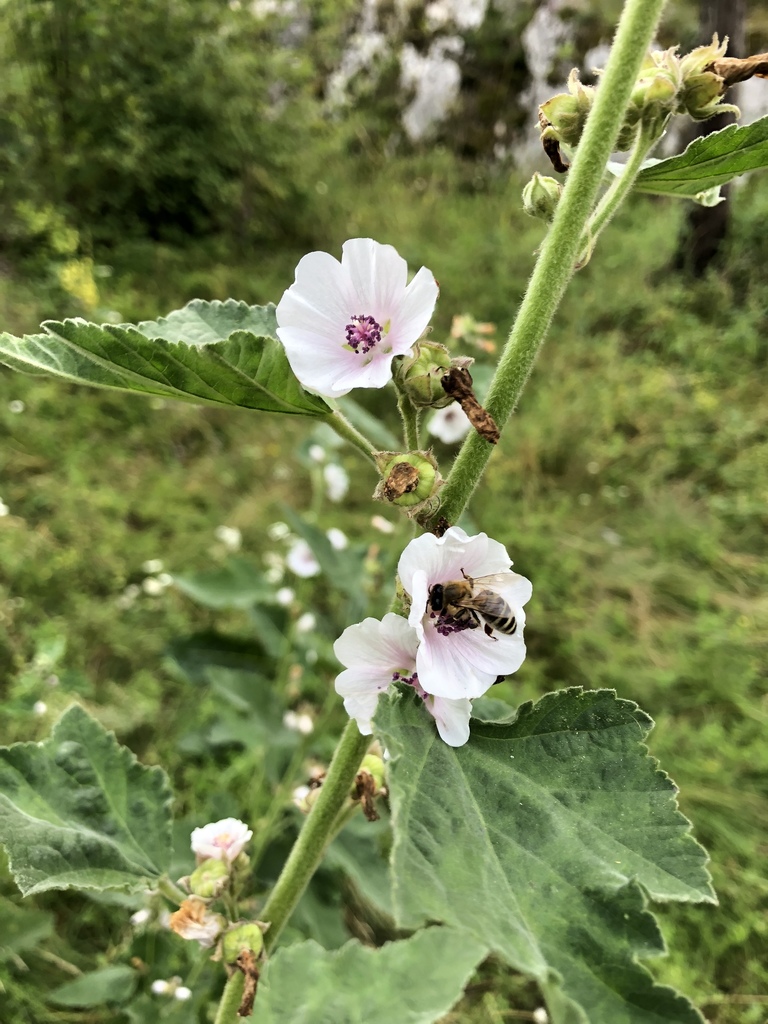
Overview
Marshmallow is one of the great soothing, moistening herbs of the Western tradition. Its root is more than 10% mucilage, a slippery, gel-like substance that coats, cools and calms irritated tissue. It is the herb for tissues that feel dry, hot and inflamed, in the throat, lungs, gut, bladder or skin, and as a member of the gentle mallow family it is both food and medicine.
Plant family
Malvaceae
Parts used
Root primarily; leaf and flower also used (seeds historically).
Actions
Demulcent · Emollient · Anti-inflammatory · Nutritive · Diuretic · Expectorant · Antitussive · Vulnerary · Laxative
Affinities
Skin and mucous membranes · Upper digestive tract · Kidneys and bladder · Lungs and throat
Body systems
Respiratory · Digestive · Urinary · Integumentary
Taste profile
The root is sweet, slightly salty, cool and mucilaginous.
Energetics
Cooling and moistening.
Tissue states
Dry · Hot · Atrophy
Traditional use
Marshmallow has been used since ancient times; the name Althaea comes from the Greek for 'heal all.' Hippocrates used a root decoction externally to stop bleeding and internally to nourish after blood loss. Greeks and Romans ate the root as a vegetable, and the French first made the marshmallow sweet from its gummy root juice to soothe coughs and babies' upset tummies. It was used for canker sores, gum disease, laryngitis and bronchitis, to lubricate a dry constipated bowel yet also to cool diarrhea and dysentery, to ease childbirth, and to increase breast milk. Poultices were laid on hard swellings, swollen glands and breasts, boils, bruises, sore joints, red eyes and splinters.
Current use
Marshmallow root is approved in Europe (Commission E, ESCOP, EMA) for irritation of the mouth and throat and the dry cough that goes with it, and for mild stomach irritation. It is used to soothe dry, tickly coughs and scratchy throats, especially at night and in children (as a syrup), to calm acid or burning stomach and ulcers, to comfort an irritated bowel in colitis and Crohn's (as support alongside medical care), and to ease the bladder and kidneys in cystitis, painful scanty urination and the passage of stones. It is often blended with stronger or more irritating herbs to soften them. On the skin it is used for dryness, chapping, eczema and itch, in baths, pastes and baby skin care. It is also the sustainable choice over slippery elm, a slow-growing tree that has been overharvested.
Preparation
Root, leaf and flower are all used and are fairly interchangeable, but they differ: the root is richest in mucilage and best for the gut, urinary tract and dry coughs; the leaf is lighter, slightly more expectorant, and suits the chest and the bladder; the flowers are gentlest and used in cough teas. The mucilage extracts best in cool water, not alcohol: a cold infusion (soak the chopped root in cool water for several hours, then strain) draws out the mucilage with less starch, while hot water draws out more starch. It is also used as a syrup for coughs, in capsules so the powder reaches the stomach and intestines directly, as a leaf tea, and externally as a poultice, paste or bath.
Dosage guidance
Root: about 2 to 5 g as a cold infusion, up to three times daily (daily total up to about 6 g, Commission E). Leaf: 1.5 to 2 g per cup of tea, up to three times daily (daily up to 5 g). Syrup: about 10 mL per dose. Capsules: two capsules three times a day was used in my notes for dry, irritated skin and gut conditions.
Cautions & contraindications
Marshmallow is a very gentle herb with a long record of safe use. Because its mucilage coats the gut, it may slow the absorption of medicines taken at the same time, so please take it at least an hour apart from medications. It may modestly lower blood sugar, so monitor if you take diabetes medicine. Syrups contain sugar.
Evidence notes
From Winter's HERB101 notes (Tissue States; Dry/Atrophic Tissue State; Assignments) citing Wood, The Practice of Traditional Western Herbalism, and Gladstar, Medicinal Herbs: A Beginner's Guide; plus a HERB302 (Demulcent Herbs) monograph page.