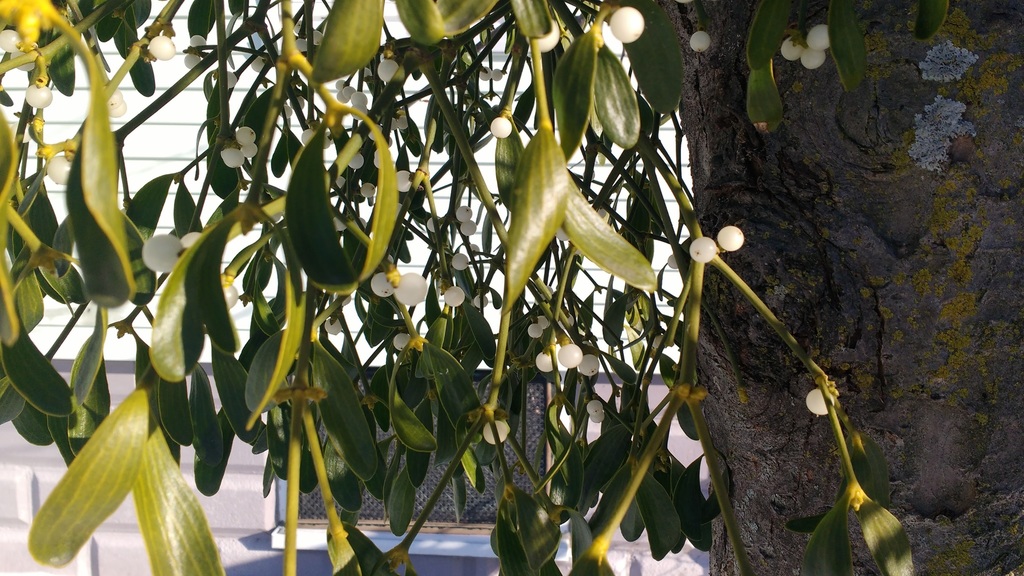
Overview
European mistletoe is an evergreen parasitic plant that grows on the branches of trees, steeped in legend from the Norse tale of Balder to the kiss beneath it. Medicinally it has a long history for the heart, blood pressure and nerves, and today it is best known for standardized injected extracts used alongside cancer care in Europe. It is a plant to respect: raw mistletoe is poisonous, so it is not for home use.
Plant family
Loranthaceae
Parts used
Leaves and young twigs, harvested before the berries form; berries are not used.
Actions
Hypotensive · Nervine · Sedative · Antispasmodic · Immunostimulant · Cytotoxic
Affinities
Heart · Nervous system
Body systems
Cardiovascular · Nervous · Immune
Taste profile
Bitter-sweet and slightly astringent.
Energetics
Cooling (traditionally described as bitter and sweet).
Traditional use
The Celts revered mistletoe, especially the rare oak mistletoe, and its role in kissing traditions comes from Norse myth and old fertility beliefs. French herbalists used it for epilepsy, nervous disorders and spasmodic conditions such as St. Vitus' dance (chorea). Elsewhere it was prescribed for giddiness, stroke and hemorrhage, to stimulate glands, as a heart and spleen tonic and digestive aid, for hysteria, arteriosclerosis and joint degeneration, and as a folk cancer remedy. In the 1920s it entered anthroposophic medicine as a cancer treatment, on the idea that a parasitic plant could act on a 'parasitic' disease.
Current use
In Europe, standardized mistletoe extracts (such as Iscador and Helixor) are injected under the skin by physicians as supportive care alongside conventional cancer treatment, mainly to improve quality of life, fatigue and the side effects of chemotherapy and radiation; evidence for effects on the tumors themselves is mixed and still debated. These injected products are not FDA-approved in the United States. In my studies it is described as immunostimulating, cytotoxic (damaging to abnormal cells), hypotensive (blood-pressure lowering) and calming to the nervous system, with uses for high blood pressure, hypertensive headache and dizziness, a racing heart from nerves, and an overactive mind. Animal research is exploring protective effects on heart function. These are practitioner-level uses, and the oral and injected forms are very different medicines.
Preparation
Medicinally, the leaves and young twigs are collected just before the berries form; the berries are not used. Historically, European herbalists prepared the leaf as a cold-water infusion (soaked overnight) or tincture for blood pressure and nerves. Today the main form is a standardized, fermented or aqueous extract injected under the skin by a physician. Its constituents vary with the host tree (apple, pine, fir, oak) and harvest time, which is why commercial products are labeled by host tree. Please don't confuse European mistletoe with American mistletoe (Phoradendron), a different and also toxic plant.
Dosage guidance
No home dosing is given here. Injected extracts are dosed only by a physician. Oral use of any mistletoe should only happen under a qualified practitioner, and raw berries or leaves should never be eaten.
Cautions & contraindications
Mistletoe is not for home use. All parts of the raw, unprocessed plant (leaves, stems and especially the berries) are toxic; eating them can cause vomiting, diarrhea, abdominal pain, a slow heart rate, low blood pressure, drowsiness and, in larger amounts, seizures. My textbook mentions a figure of 1 to 3 berries; poison-control reports agree that a child who accidentally swallows one or two berries usually has mild or no symptoms, but that is about accidents, not a safe dose, and no reputable source gives a safe number of berries to eat. Please never eat the berries on purpose, and keep holiday mistletoe away from children and pets. Avoid it in pregnancy and breastfeeding (it is an emmenagogue, meaning it can bring on menstrual flow). It may add to blood pressure, heart and diabetes medicines and to immune-suppressing drugs. Injected extracts commonly cause redness and swelling at the injection site, fever and flu-like symptoms, and rarely serious allergic reactions; they are avoided with some brain tumors, leukemias and lymphomas, high fevers and hyperthyroidism.
Why: mistletoe contains two main groups of toxic proteins. Viscotoxins are small proteins that punch holes in cell membranes, making cells leak and die. Mistletoe lectins (ML-I, II and III) are ribosome-inactivating proteins: they enter cells and switch off the machinery that makes proteins, which kills the cell and also stirs up an immune response. That is the basis of both its interest in cancer care and its danger when the raw plant is eaten.
Evidence notes
From Winter's HERB202 notes (Module 2, ABC HerbClip News 'Mistletoe - The Mystical and the Medicinal', Lori Glenn, 2009) and HERB302 Cardiovascular Support module page (Latin name and family).