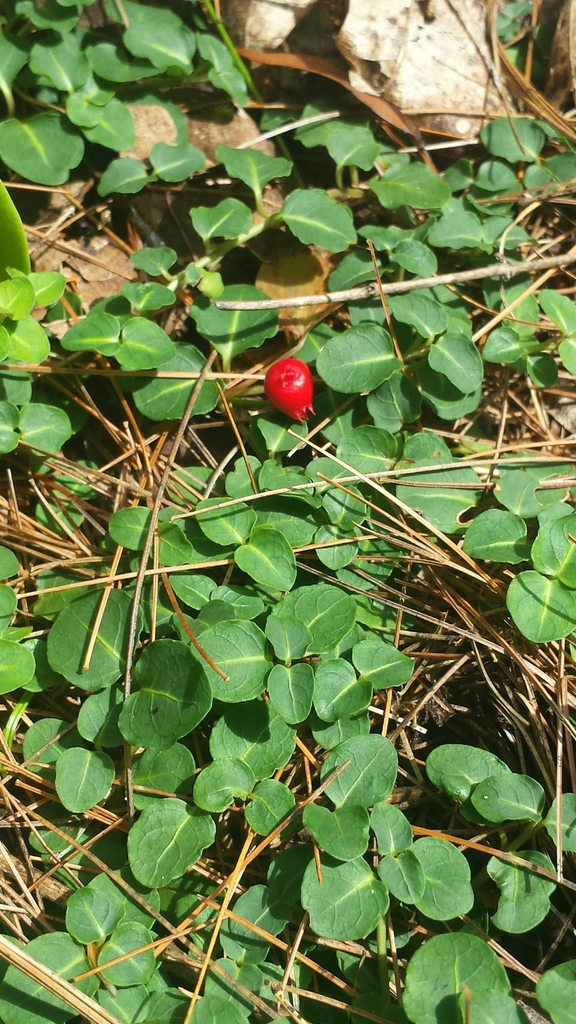
Overview
Partridge berry is a tiny evergreen vine that carpets the forest floor, with paired white flowers and bright red berries. Native American peoples and later herbalists knew it as a woman's herb, a classic uterine tonic used in the weeks before birth. It is a small, quiet and fascinating plant. Please note it is a different plant from the lingonberry, which is sometimes also called partridgeberry in Canada.
Plant family
Rubiaceae
Parts used
Leaves and stems (aerial parts); berries.
Actions
Uterine tonic · Partus Preparator · Astringent · Diuretic · Emmenagogue · Antispasmodic · Nervine
Affinities
Uterus · Reproductive system · Urinary tract
Body systems
Reproductive · Urinary · Nervous
Taste profile
Bitter and astringent (drying and puckering); the berries are mild and bland.
Energetics
Cooling and drying.
Tissue states
Relaxed · Damp
Traditional use
Several Native American nations used partridge berry in the final weeks of pregnancy to prepare for and ease childbirth, and for painful or irregular periods, sleeplessness, rheumatic aches (achy, stiff joints and muscles) and fluid retention. A wash was used for sore nipples, hives and swellings. Eclectic physicians of the 1800s used it as a partus preparator (an herb taken to prepare the body for labour) and for heavy periods and pelvic congestion.
Current use
Partridge berry is used by herbalists as a tonic for the uterus, to support comfortable, regular cycles and to ease menstrual cramps, and in formulas for the hormonal transitions of a woman's life, such as puberty and menopause. It is also used as a mild astringent and diuretic. There are no modern clinical trials on it, so this use rests on tradition.
Preparation
I would recommend making it as an infusion (steeped tea): about two teaspoons of the dried leaves, with the berries if you like, in a cup of freshly boiled water, steeped 10-15 minutes. It can also be made as a decoction (simmered tea), a tincture, or a wash for the skin. The leaves and stems carry most of the astringent, toning tannins and are the main medicinal part; the berries are edible, mild and mostly used for food or added to tea.
Dosage guidance
Herbalist reference for non-pregnant adults: 2-4 g of dried herb daily as tea, or 2-4 mL of tincture in water three times a day. In pregnancy, only under a qualified practitioner.
Cautions & contraindications
Partridge berry acts on the uterus. Please avoid it in pregnancy except in the final weeks, and then only under a qualified practitioner's supervision; never use it to bring on labour early. Modern safety data are limited. Its tannins can upset the stomach and may reduce the absorption of iron and medicines if taken together. It is slow-growing and declining in some areas, so please buy cultivated or responsibly harvested plant material.
Evidence notes
Winter's HERB303 page is a course resource template only (name, Latin name, family). Web-sourced seed pending Winter's review. Sources: Plants For A Future (https://pfaf.org/user/Plant.aspx?LatinName=Mitchella+repens); Christopher Hobbs Herbal Therapeutics Database, Partridge Berry (https://christopherhobbs.com/herbal-therapeutics-database/herb/partridge-berry/)