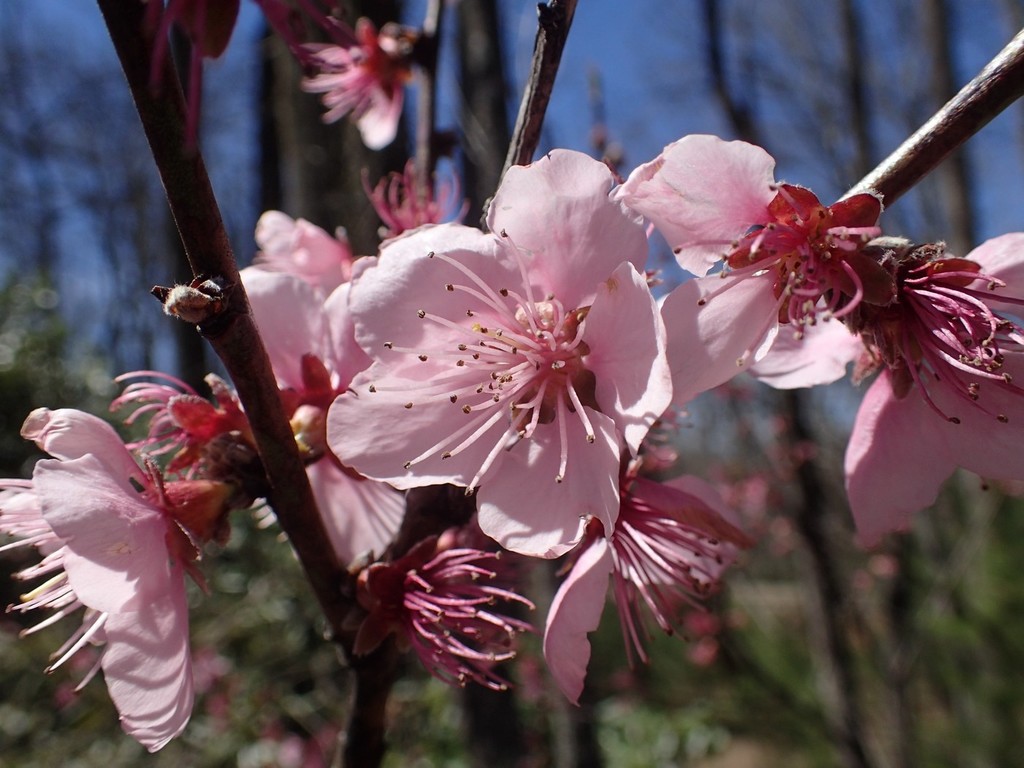
Overview
The peach tree's leaves, young twigs and bark make a gentle, cooling remedy that has long been valued for calming an irritated stomach and soothing frazzled nerves. Slightly mucilaginous (softly slippery and soothing), peach both settles and tones, and it is especially suited to sensitive people who overheat easily. It belongs to the rose family, alongside almond, cherry and hawthorn.
Parts used
Leaves, young twigs and bark of small limbs; whole unbroken pits (for cold decoction); fruit.
Actions
Sedative · Tonic · Demulcent · Antiemetic · Nervine · Laxative · Anthelmintic · Diuretic · Expectorant · Febrifuge
Affinities
Nervous system · Skin and mucosa · Respiratory · Gastrointestinal · Sexual-urinary
Body systems
Digestive · Nervous · Respiratory · Integumentary · Urinary
Taste profile
Sour, bitter and sweet, and slightly mucilaginous.
Energetics
Cool and moist.
Tissue states
Hot · Dry · Atrophy
Traditional use
Eclectic and Thomsonian practitioners, the American physician-herbalists of the 1800s (Fyfe, Thomson, Brown, Cook), considered peach one of the best remedies for an irritated stomach: when the tongue is long, pointed and red at the tip, and the person is so nauseated that even a sip of water or the smell of food brings on vomiting. They used it for gastritis, for vomiting in pregnancy, for children's summer diarrhoeas and dysentery, and to restore tone to the stomach after a long illness. Larger doses of the leaf infusion acted as a mild laxative and were used to expel worms, and peach leaves appear in anthelmintic formulas with wormwood and rue. Eva Graf used a tea of peach pits or twigs for months as a digestive tonic for weak protein digestion and gas, and Heinerman recommended peach fruit juice for fevers, indigestion and morning sickness. Other indications in Winter's notes include whooping cough, food allergies, leucorrhoea (vaginal discharge), fever and clammy, water-logged skin.
Current use
Peach leaf and twig are used by herbalists to soothe stomach irritation, nausea and nervous vomiting, including morning sickness, and to calm restlessness, overstimulation and sleeplessness, especially in over-excited children. They are also used for irritated upper airways and seasonal allergies, irritable coughs, an irritable bladder, and heat and irritation of the skin in fair, sensitive people. In Chinese medicine the processed kernel (tao ren) is prescribed by practitioners to move stagnant blood. Modern research is limited to lab and animal studies.
Preparation
Heat destroys peach's virtues, so it is made as a cold infusion (steeped in cool water) of the leaves, small twigs and the bark of small limbs, or macerated (soaked) in brandy or alcohol to make a tincture. The leaves are the gentlest part and are chosen for nausea, nerves, coughs and children. The bark is stronger than the leaves (Tommie Bass) and suits more stubborn cases. The fruit and its juice are food and a mild version of the leaf. About the pit and kernel: the pit (also called the stone or seed) is the whole hard, woody shell in the centre of the fruit; the kernel is the soft, almond-like seed sealed inside that shell. In the old preparations, whole unbroken pits were cleaned and dried and used for a cold decoction or tea, and any pit that cracked open during preparation was thrown away, so the kernel inside never went into the tea. The kernel itself is never eaten raw.
Dosage guidance
Tincture or extract: 1 to 10 drops (Fyfe). Cold leaf infusion: about a tablespoon every hour or two for stomach irritation (Brown). Pit or twig tea: several tablespoons before and after meals as a digestive tonic (Graf). Larger, laxative doses for worms should only be used under a practitioner.
Cautions & contraindications
Please never eat the kernel (the seed inside the pit) raw, and discard any pit that breaks open. The kernel, and to a lesser degree the leaves and bark, contain amygdalin, a cyanogenic glycoside: when the kernel is chewed or digested, it releases hydrogen cyanide, which blocks cytochrome oxidase, the enzyme cells use to make energy from oxygen. The heart and brain are affected first, and a few kernels can poison a child. This is why the leaves and bark are used in small, cold-prepared doses and why the processed kernel (tao ren) is only for trained practitioners. Please avoid medicinal amounts in pregnancy except under a practitioner, despite the traditional use for morning sickness, and avoid in children except under guidance.
Evidence notes
From Winter's Herb101 notes (Assignments; Heat - Excited Tissue State; Tissue States), citing Wood, The Practice of Traditional Western Herbalism pp. 141-145, with references to Fyfe, Thomson, Brown, Cook, Graf, Heinerman, Tommie Bass and Kate Gilday.