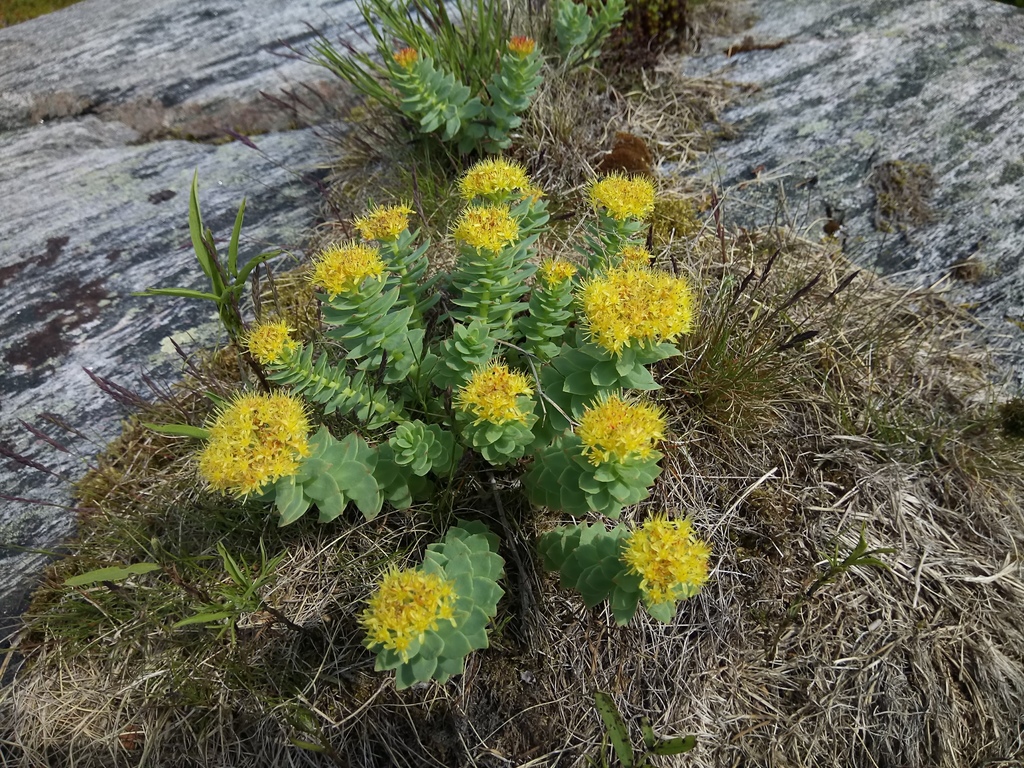
Overview
Roseroot, also called golden root or arctic root, is a hardy high-altitude plant of arctic Europe and Asia whose dried root smells softly of roses. It is a well-known adaptogen, meaning an herb traditionally used to help the body cope with physical, mental and environmental stress. In Russia and Scandinavia it has long been a tonic for energy, stamina and a clear, focused mind.
Plant family
Crassulaceae
Parts used
Rhizome and root; the leaves and shoots are edible.
Actions
Adaptogen · Tonic · Stimulant · Anti-fatigue · Nootropic · Antidepressant · Anxiolytic · Antioxidant · Neuroprotective · Astringent
Affinities
Nervous system · Mind and memory · Stamina and endurance
Body systems
Nervous · Cardiovascular · Immune
Taste profile
Slightly bitter and astringent; the dried root has a rose fragrance.
Energetics
Cooling and drying in traditional Chinese and Western herbal descriptions, with a stimulating quality.
Traditional use
It has been used for centuries in Russia and Scandinavia as a tonic for tiredness, a short attention span and poor memory, and to increase the capacity for mental work. It was also taken to strengthen resistance to cold, illness and the hardships of northern life. The leaves and shoots were eaten raw in salads or cooked like spinach, and the root was eaten raw or cooked.
Current use
Roseroot is used to support energy and stamina, mental performance and concentration, recovery after exercise, and a steady mood during stressful periods. In a 20-day placebo-controlled study, students taking a low daily dose before exams reported less mental fatigue and better well-being, and a study of night-duty physicians found less stress-related fatigue. A small trial suggested benefit in generalised anxiety. In competitive rowers it raised antioxidant levels in the blood, though it did not reduce exercise-induced oxidative damage, and it did not help blood oxygen at altitude in a short study. Animal research suggests it raises stress-protective proteins (heat shock proteins) and serotonin in the brain. European regulators accept it as a traditional remedy for temporary relief of stress symptoms such as fatigue and a sense of weakness. Reviews describe the evidence as promising but limited by small, varied studies.
Preparation
The rhizome and root are the medicinal parts, harvested from plants several years old. Today it is most often taken as a standardized root extract (often standardized to rosavins and salidroside, the compounds linked to its adaptogenic effect; rosavin is unique to this species, so it helps confirm the real plant). It can also be made into a tincture or a simmered root decoction. The leaves and young shoots are a slightly bitter food rather than a medicine. It is best taken in the morning or early afternoon, because its stimulating effect may disturb sleep if taken late. In the garden it likes fertile, well-drained, sunny loam; it can be grown from seed or divided in late summer to autumn, and male and female plants are needed for seed.
Dosage guidance
Studied extract doses: for athletic performance, 200 mg once daily or 100 mg twice daily; for fatigue, 50 mg twice daily or 370 to 555 mg once daily; for anxiety, 170 mg twice daily. The EU traditional monograph suggests limiting self-care use to about two weeks before reviewing it with a practitioner. Please follow a qualified practitioner's guidance.
Cautions & contraindications
Please avoid roseroot if you have a known allergy to it or to other members of the stonecrop family (Crassulaceae). Please avoid it during pregnancy and breastfeeding, and in children, because it has not been researched enough. Please use it cautiously with heart-rhythm (anti-arrhythmic) medications, with other adaptogens or stimulants, alongside antibiotics or chemotherapy, with antidepressants, and if you have a neurological or psychiatric condition, including bipolar disorder. Restlessness, irritability, jitteriness and sleeplessness have been reported, especially at higher doses or when taken late in the day.
Evidence notes
From Winter's HERB304 notes (monograph M5 P-T), citing Kelly (2001, Alternative Medicine Review), Spasov et al. and Darbinyan et al. (Phytomedicine 2000), Panossian et al. (2009), Barnes et al., Herbal Medicines, and others.