Overview
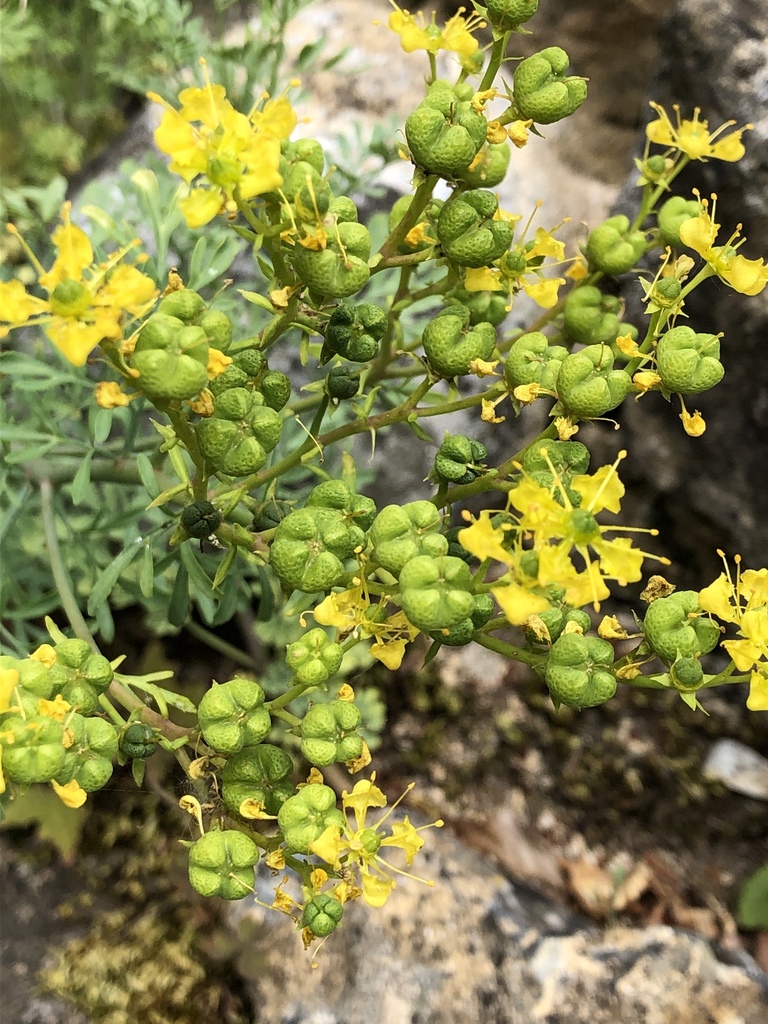
Rue is a blue-green, strongly scented garden herb in the citrus family with fern-like leaves and small, cupped yellow flowers. It has an ancient history in folk medicine and protective lore. It is beautiful in the garden but genuinely toxic, so today it is admired far more than swallowed.
Plant family
Rutaceae
Parts used
Leaves and young shoot tops (historically).
Actions
Antispasmodic · Emmenagogue · Abortifacient · Antitussive · Anthelmintic · Carminative · Rubefacient
Affinities
Uterus · Eyes
Body systems
Reproductive · Nervous
Taste profile
Strongly bitter, acrid and aromatic.
Energetics
Warming and drying.
Traditional use
Since ancient times rue was used to bring on absent menstruation (amenorrhea), often combined with false unicorn root and life root, and in larger doses it was misused to cause abortion, often with fatal results for the woman. Its antispasmodic quality was used to relax gripping pains of the gut and spasmodic coughs, and it was said to ease raised blood pressure by improving peripheral circulation. Chewing a fresh leaf was a folk remedy for tension headaches and nervous palpitations. It was also used for eye strain and weak eyesight, for worms and flatulence, and as a protective herb against disease and the 'evil eye'.
Current use
The effectiveness and safety of rue's traditional uses are not well documented in modern research, and its toxicity outweighs any proven benefit for home use. Today it appears mainly in homeopathic preparations (Ruta graveolens, used for sprains, bruised tendons and eye strain), where the plant is diluted to a non-toxic level, and as an ornamental and companion plant. Laboratory studies have found antispasmodic, antimicrobial and anti-inflammatory activity in its compounds, but these are not a basis for home use.
Preparation
Historically the above-ground parts (leaves and young shoot tips, gathered before flowering) were used in small infusions, tinctures and fresh juice, and today in homeopathic dilutions. Please handle the plant with gloves and long sleeves, and avoid touching your skin in sunshine afterwards, because its sap can burn. It is not recommended for home internal use.
Dosage guidance
Not for home internal use. Historical texts give small tea and tincture doses, but toxicity can occur close to these amounts, so please use rue only under a qualified practitioner, if at all. Homeopathic preparations are a separate matter.
Cautions & contraindications
Please strictly avoid rue in pregnancy and while trying to conceive: it stimulates the uterus to contract and can cause miscarriage, and doses taken to induce abortion have caused severe poisoning and death. Large amounts can cause serious, even fatal, liver and kidney injury, vomiting, abdominal pain, confusion and convulsions, so avoid it with liver or kidney disease. The sap and leaves contain furanocoumarins (such as psoralen and bergapten). These compounds soak into skin cells and, when struck by the sun's ultraviolet light, lock onto the cells' DNA and damage it, causing a delayed, blistering, burn-like rash called phytophotodermatitis that can leave dark marks for months. Rue essential oil is not for aromatherapy or skin use. Keep it away from children and pets.
Evidence notes
From Winter's HERB303 notes (M2 - Emmenagogues); page holds only the course template. Web-sourced seed pending Winter's review. Sources: Plants For A Future (https://pfaf.org/user/Plant.aspx?LatinName=Ruta+graveolens); Wikipedia: Ruta graveolens (https://en.wikipedia.org/wiki/Ruta_graveolens)