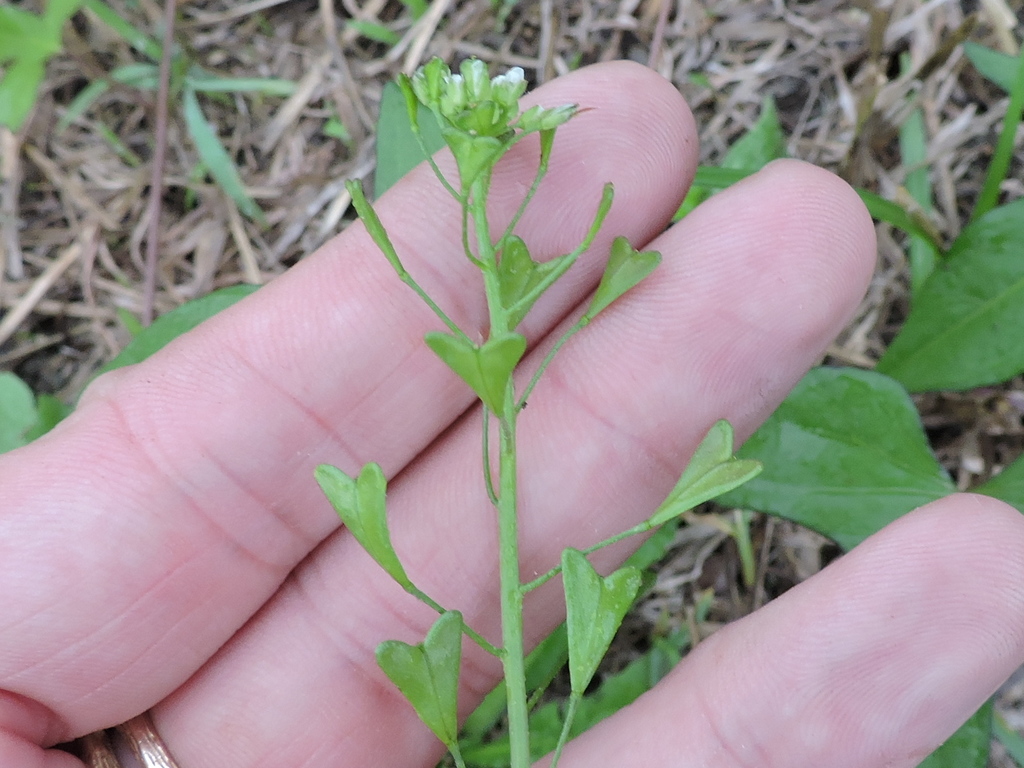
Overview
Shepherd's purse is a humble, hardy weed of the mustard family that grows nearly everywhere in the world, named for its little heart-shaped seed pods that look like an old leather purse. People have eaten it for at least eight thousand years. Herbally, it is best known as a styptic, an herb that helps slow bleeding, especially heavy menstrual flow.
Plant family
Brassicaceae
Parts used
Above-ground parts (herb with seed pods); seeds, leaves and seed oil as food.
Actions
Styptic · Hemostatic · Astringent · Diuretic · Urinary Antiseptic · Antimicrobial · Uterine Stimulant · Vulnerary
Affinities
Uterus · Urinary tract · Blood
Body systems
Reproductive · Urinary · Cardiovascular
Taste profile
Mildly peppery, bitter and slightly pungent, like a mild cress.
Energetics
Cooling, drying and astringent.
Traditional use
Shepherd's purse has long been valued as one of the best styptics for bleeding of many kinds: from the stomach, lungs, uterus and especially the kidneys and bladder (blood in the urine). During shortages in World War I it was used as a substitute for ergot and goldenseal to stop hemorrhage. Nineteenth-century Eclectic physicians used it for blood in the urine and heavy periods, and externally for bruises, strains and arthritis. It was also used after childbirth to stop bleeding, for catarrhal (mucus-laden) inflammation and abscess of the bladder and uterus, for cystitis with white discharge, and as a diuretic where uric acid or mineral deposits irritate the urinary tract. In China a decoction is used to lower blood pressure and stop bleeding, and in India it is applied to injured varicose veins.
Current use
Germany's Commission E approves shepherd's purse taken internally for symptomatic relief of mild heavy or irregular menstrual bleeding (menorrhagia and metrorrhagia), and applied externally for nosebleeds and superficial wounds and bruises. No modern clinical trials confirm this, but long empirical use supports it, and research points to a still-unidentified peptide as its blood-stopping principle. Laboratory studies have found two antimicrobial peptides (shepherins I and II), broad antimicrobial activity of its alkaloids and flavonoids, anti-tumour activity of fumaric acid in mice, and an extract that reduced melanin production in pigment cells, which may interest skin-care researchers. It is also mentioned for diarrhea, fluid retention, urinary irritation, headache and low blood pressure.
Preparation
The above-ground parts are used, harvested near the end of flowering when the seed pods are present, and dried quickly. It is prepared as a tea (infusion) of the dried herb, a fresh-herb decoction (simmered) for blood in the urine, a liquid extract or tincture, or a topical infusion applied to wounds, bruises and nosebleeds. Many herbalists find the fresh or freshly dried herb more effective than old stock, since it loses potency in storage. The seeds, leaves and seed oil are also eaten as food.
Dosage guidance
Tea: 2 to 4 g of dried herb (about 1 to 2 teaspoons) in 150 mL of boiling water, steeped 10 to 15 minutes, two to four times daily between meals (Commission E allows 10 to 15 g per day). Liquid extract (1:1 in 25% alcohol): 1 to 4 mL three times a day. Topically: 3 to 5 g steeped in 180 mL boiling water and applied to the area. Please don't take excessive amounts; very high doses of extract may cause heart palpitations.
Cautions & contraindications
Please don't use shepherd's purse during pregnancy (AHPA Class 2b): it may stimulate uterine contractions. Avoid it if you are allergic to it or to the mustard family (Brassicaceae), and use caution if you have a history of kidney stones. It contains tyramine, a compound that releases noradrenaline (a stress hormone) from nerve endings and can raise blood pressure and heart rate; please avoid it if you take MAO-inhibitor antidepressants, which stop the body breaking tyramine down, and use caution with heart conditions or blood pressure medicines. It also contains sinigrin, which breaks down into allyl isothiocyanate and related compounds that can interfere with the thyroid's uptake of iodine, so large or long-term amounts may affect thyroid function; please check with your doctor if you have a thyroid condition. Heavy or unusual bleeding should always be assessed by a doctor.
Evidence notes
From Winter's HERB304 notes (M1 A-C), citing the Natural Medicines Database monograph and the AHPA Botanical Safety Handbook.