Overview
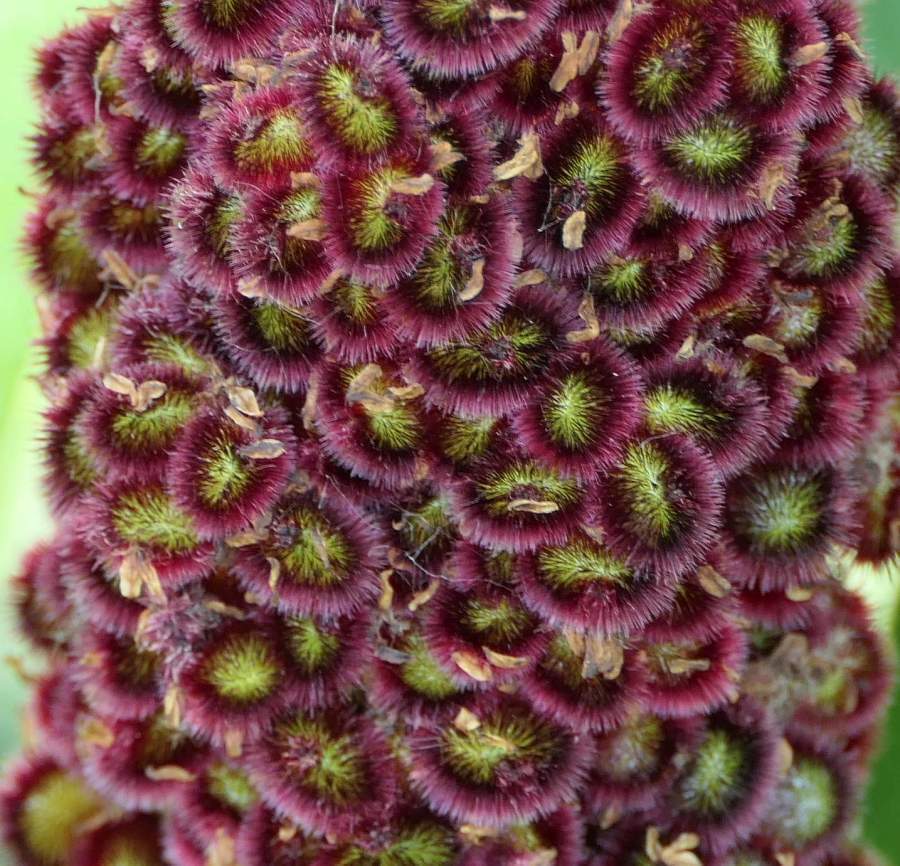
Sumac is a striking shrub, with velvety antler-like branches in staghorn sumac, whose astringent bark and sour, tangy red berries have been valued from ancient Greek and Arabic medicine to Appalachian and Native American folk practice. It is a classic toning herb for tissues that are too lax and losing fluids; astringent means it gently tightens and firms. The ground red berries of the Mediterranean species are also a lovely lemony spice. Edible sumacs have red berries; poison sumac, a different plant, has white berries.
How it compares: Staghorn sumac (Rhus typhina), smooth sumac (R. glabra), fragrant sumac (R. aromatica) and Sicilian sumac (R. coriaria) are closely related and, according to Matthew Wood, fairly interchangeable for their main uses, because all are rich in astringent tannins and the red-berried species share sour organic acids. Fragrant sumac is the one historically singled out for urinary incontinence, excessive urination and diabetes, and smooth sumac was favoured for mouth rinses and foul-smelling diarrhea. Sicilian sumac is the culinary spice. Poison sumac is not a true Rhus at all but a Toxicodendron, related to poison ivy; it is never used and is dangerous to touch.
Parts used
Bark, berries, leaves (fragrant sumac).
Actions
Astringent · Tonic · Refrigerant · Diuretic · Antiseptic · Hemostatic · Antioxidant
Affinities
Kidneys · Skin · Fluids
Body systems
Urinary · Integumentary · Respiratory · Digestive · Reproductive
Taste profile
The bark is astringent. The berries are sour, cooling and astringent, with a lemony tang.
Energetics
The bark is astringent and neutral to slightly warming; the berries are cooling.
Tissue states
Relaxed · Damp
Traditional use
Sicilian sumac (Rhus coriaria) was used in Greek and Arabic medicine. In North America, settlers learned the native species from Indigenous peoples. Fragrant sumac was introduced to 19th-century American medicine by Dr. J. T. McClanahan in 1879 for urinary incontinence and excessive urination, became an official remedy, and was used for diabetes insipidus and diabetes mellitus with copious urine. Herbalist Phyllis Light describes a constitutional 'sumac person' from Appalachian tradition: thin, tired, pale, low in immunity, with weak kidneys and fluid loss. Sumac was also used for fever with night sweats and thirst, diarrhea with foul stools, bronchitis with free secretion, weak capillaries and bleeding, a swollen prostate with painful urination, impotence with night-time urination, stiffness and weakness of the lower back and knees, and skin fungus linked with damp. The sour berries were steeped into a cooling 'sumac-ade'.
Current use
Sumac is used in traditional Western herbalism to support urinary tone where there is frequent, pale, profuse urination with weakness and no active inflammation, including bedwetting in children and the elderly, and to help steady the body when fluids are being lost through sweat, urine or other secretions. It can be useful as a mouth rinse for spongy, bleeding gums, canker sores and mouth ulcers, and for colds and flu with copious, runny secretions and postnasal drip. The berries are rich in tannins, gallic acid and antioxidants, and small clinical studies of culinary sumac (Rhus coriaria) suggest modest benefits for blood sugar and cholesterol in people with type 2 diabetes. Historic case reports of fragrant sumac for diabetes are interesting but are no substitute for medical diabetes care.
Preparation
Bark: traditionally gathered in spring while the sap is running, then prepared as a decoction (simmered tea) or preserved in alcohol, glycerin or sugar. The bark is purely astringent, so it suits fluid loss and laxity without irritation. Berries: harvested as soon as they ripen and cleaned of insects before use, then cold-steeped as a sour drink, infused as a tea, tinctured, or dried and ground as a spice. The berries are sour, cooling and astringent, so they suit relaxed tissue with some irritation or heat, such as sore throats, mouth ulcers and urinary irritation. Cold-steeping the berries (rather than boiling) keeps the drink pleasant and less bitter. Leaves of fragrant sumac were also used alongside the bark.
Dosage guidance
Tincture: usually 5 to 30 drops (per Fyfe), up to three times a day; some practitioners use as little as 3 drops three times a day. Berry drink: a handful of berries cold-steeped in water and strained through cloth. Please work with a practitioner for medicinal use, especially with diabetes or urinary symptoms.
Cautions & contraindications
Please make absolutely sure of your identification: poison sumac (Toxicodendron vernix) has white or greyish berries hanging in loose clusters and grows in swamps, and its oil, urushiol, binds to skin proteins and triggers a severe allergic rash like poison ivy. Edible sumacs have upright clusters of fuzzy red berries. Sumacs are in the cashew family (Anacardiaceae), so people allergic to cashews, mangoes or pistachios should be cautious. Sumac is not used for fluid retention when kidney stones are present, and it suits cases without active inflammation. Please don't use it to replace diabetes treatment; if you take blood-sugar medicines, monitor closely. Because its tannins are strongly astringent, large amounts may cause constipation or stomach upset. Avoid medicinal amounts during pregnancy and breastfeeding, as safety has not been studied.
Evidence notes
From Winter's Herb101 notes (Assignments; Damp, Flowing, or Relaxed Tissue State; Tissue States), citing Wood, The Practice of Traditional Western Herbalism pp. 202-206, with references to Phyllis Light, Fyfe, McClanahan and Goss.