Overview
True Solomon's seal is a woodland lily relative whose sweet, knobbly, bone-white root has been one of my dearest companions for many years. It is prized as a remedy for the musculoskeletal system, meaning the muscles, bones, joints, tendons and ligaments, and especially for the tension-bearing tissues that heal slowly because they get little blood flow. Its gift is balance: it is traditionally said to help tendons and ligaments find the right tension, whether they are too tight or too loose, while gently moistening dry, inflamed tissue.
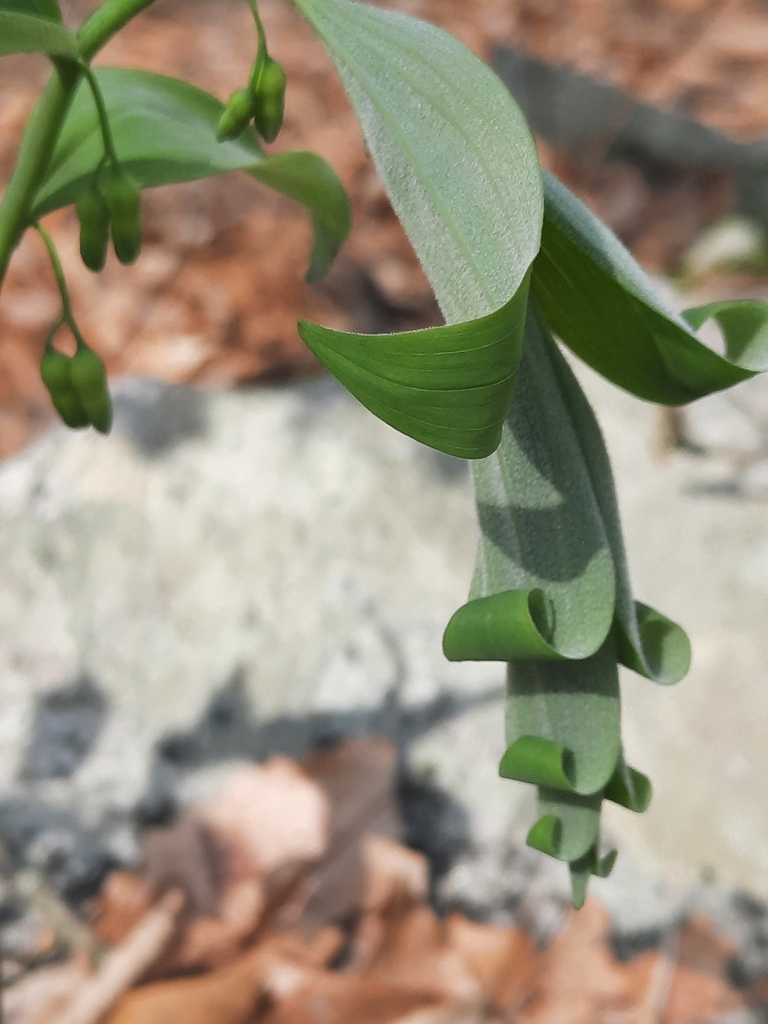
How it compares: Despite the name, true Solomon's seal (Polygonatum) and false Solomon's seal (Maianthemum racemosum, formerly Smilacina) are different plants, and they are not interchangeable. True Solomon's seal hangs its bell-like flowers and dark berries in pairs beneath an arching stem; false Solomon's seal carries a fluffy plume of flowers at the stem tip and red speckled berries. Only true Solomon's seal has the sweet, mucilaginous root with the long tradition for tendons, ligaments and joints. False Solomon's seal root has been used in Native American medicine mainly for coughs, as a wash for wounds and for rheumatic complaints, but it lacks the musculoskeletal reputation. The Chinese species (P. odoratum and P. sibiricum) share the moistening character and are used more as internal tonics for dryness of the lungs and stomach.
Parts used
Rhizome (root) only. The berries are toxic and never used.
Actions
Demulcent · Nutritive · Tonic · Anti-inflammatory · Vulnerary · Emollient · Expectorant · Astringent · Musculoskeletal Tonic
Affinities
Tendons · Ligaments · Joints · Muscles · Bones · Mucosa
Body systems
Musculoskeletal · Digestive · Respiratory · Reproductive · Integumentary
Taste profile
Sweet and mucilaginous (slimy), slightly bitter and faintly acrid (sharp).
Energetics
Cool and moist; nourishing and moistening (a tonic for dry, atrophic tissue).
Tissue states
Dry · Atrophy
Traditional use
John Gerard brought true Solomon's seal into English-language herbalism in 1597, noting that the old Greek and Roman writers had dismissed it as poisonous (only the berries are). He recorded that country healers in Hampshire pounded the root into ale for broken bones, and laid the fresh root as a poultice over joints that had been set back in place, over swellings after fractures, and over bruises and black eyes, including deep, internal bruising. William Salmon (1710) described the root mixed into wheat or rye meal and applied outwardly to close fresh wounds and to strengthen a weak back. Matthew Wood revived it for modern Western herbalism, and its old indications also include heavy menstrual flow, vaginal irritation, hemorrhoids, poison ivy rash applied externally, premature ejaculation, and toning the ovaries and the estrogen side of the cycle. In Chinese medicine the related species (yu zhu, P. odoratum, and huang jing, P. sibiricum) are classic moistening yin tonics. The knobbly root, which looks like knuckles and vertebrae and even shows little spurs, is a famous example of the doctrine of signatures, the old belief that a plant's appearance hints at the part of the body it helps.
Current use
This botanical truly helped me after I hurt my spine. I made it into a tincture and applied it topically along my spine and to my knees, and to the places that don't get good blood flow and are slow to heal, like tendons, ligaments and stubborn joints. These days I prefer to make it into an infused oil blended with other herbs (I pair it with comfrey) for the same purpose: deeper sports-type injuries such as muscle and tendon strains, ligament sprains, sore joints and even disc injuries. In the herbal tradition it is used for stretched or loose ligaments that won't hold after an adjustment, repetitive-strain complaints like carpal tunnel, tennis elbow and jogger's knee, tendonitis, stiff, achy or dry joints after old injuries, and joints that feel poorly lubricated. Taken internally in small doses, it is also used as a soothing, moistening remedy for irritated mucous membranes (the moist linings of the gut, lungs and vagina), for dry coughs, and as a nourishing food for people who are weak and worn down. Please know this rests on traditional and practitioner experience; it has not been tested in clinical trials for these uses.
Preparation
Only the rhizome (the creeping underground root) is used. For external use it is made into a tincture rubbed into the area, an infused oil (simmering or steeping the root in oil), a salve, or a poultice of the fresh, mashed root. The root is so rich in sugars that it makes a sweet extract turn sticky, so grain alcohol or oil is the preferred menstruum (extracting liquid). Internally it is taken as a tincture in drop doses, or the dried root can be simmered as a decoction or cooked as food. It blends well as a base for joint and injury formulas: with St. John's wort when nerves are involved, mullein root for alignment issues, horsetail for bone and cartilage repair, and arnica topically for pain from injury. Because native stands are shrinking, it should be harvested sustainably: cut away only the older back portion of the rhizome a few inches behind the stem and leave the growing bud in the ground, or better, buy cultivated root.
Dosage guidance
Tincture: Matthew Wood and Jim McDonald describe very small drop doses, about 3 to 5 drops once to three times a day, most people finding 5 to 15 drops enough; McDonald notes it can be raised gradually to 30 drops three times a day if needed. Topically: oil, salve or tincture rubbed in two to three times a day. Please work with a qualified practitioner for serious injuries, and see a doctor for any fracture or suspected tear.
Cautions & contraindications
Use only the root. The blue-black berries are toxic and can cause vomiting and diarrhea; keep them away from children and pets. Please make sure of your identification: young plants can be confused with lily of the valley, which contains cardiac glycosides (heart-active compounds) and is poisonous, and with false Solomon's seal. Solomon's seal itself contains small amounts of related heart-active compounds; they appear to be too low to matter at normal doses, but if you take heart medication, please check with your doctor first. Avoid in pregnancy and breastfeeding, as safety has not been established. It is very moistening, so it is less suited to people with a lot of damp, congested mucus.
Evidence notes
From Winter's Herb101 notes (Assignments; Dry/Atrophic Tissue State; Tissue States), citing Matthew Wood, The Practice of Traditional Western Herbalism (pp. 191-195), which draws on John Gerard (1597/1635) and William Salmon (1710).