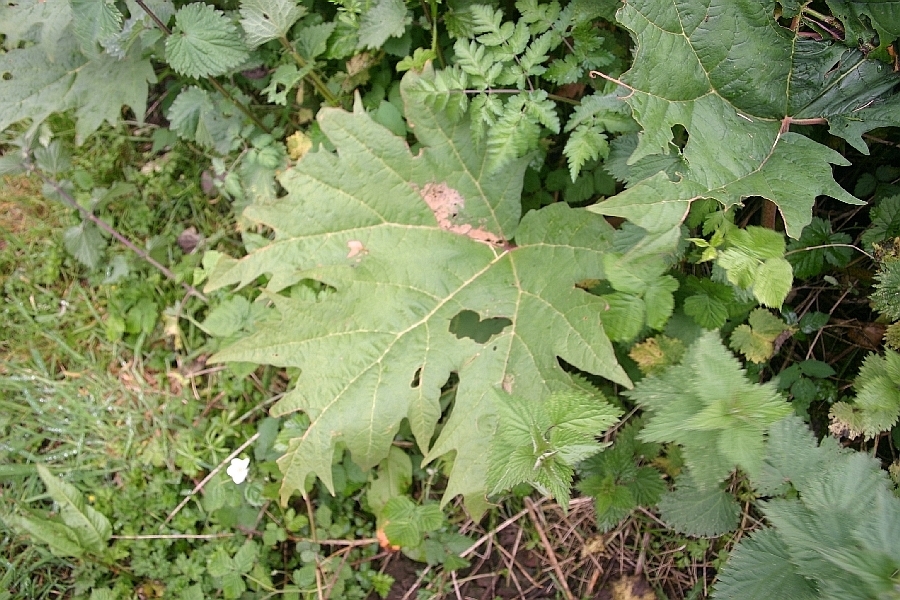
Overview
Turkey rhubarb is a stately Asian rhubarb whose golden-yellow root has been used as medicine in China for around two thousand years and traded west along the Silk Road. It is best known as a stimulant laxative, yet in small doses its tannins make it astringent and tightening, so tradition used it both for constipation and for loose bowels. It is a strong root, meant for brief and careful use.
How it compares: Turkey rhubarb (Rheum palmatum and R. officinale) is not the same as garden rhubarb (Rheum rhabarbarum / R. x hybridum), even though both are Rheum. Garden rhubarb is grown for its sour leaf stalks, eaten as food; its root contains far less of the laxative anthraquinones and is not the medicinal root. So they are not interchangeable as medicine. With both plants, the leaves are poisonous because of their oxalate content.
Plant family
Polygonaceae
Parts used
The dried root and rhizome (underground stem). The leaves are poisonous and never used.
Actions
Laxative · Purgative · Astringent · Bitter · Cholagogue · Stomachic · Anti-inflammatory · Antimicrobial
Affinities
Bowels · Liver · Gallbladder
Body systems
Digestive
Taste profile
Bitter and astringent, with a slightly sour note.
Energetics
Cold and bitter; draining and downward-moving (strongly so in Chinese medicine).
Traditional use
Traditionally it was used as a balancing digestive tonic: larger doses to move the bowels, small doses to firm up diarrhea, along with a bitter action to stir a sluggish liver and gallbladder and to improve appetite. It was also used for hemorrhoids, menstrual complaints and skin eruptions, and the powdered root was applied externally to burns. It is one of the four herbs in the well-known Essiac formula.
Current use
Turkey rhubarb root is recognised by the European Medicines Agency (as a well-established use) and by Germany's Commission E for the short-term relief of occasional constipation. Its anthraquinone compounds (described under cautions) are the active laxative principle. In Chinese medicine it remains a major herb for heat and constipation, and modern research is exploring its anti-inflammatory and kidney-protective effects, though that work is still largely laboratory-based.
Preparation
The dried root and rhizome are used. It is usually prepared as a decoction (root simmered in water) or as a tincture, powder, capsule or tablet. Long simmering breaks down some of the laxative compounds and leaves more of the tannins, which is why a lightly prepared or low dose leans laxative while a well-cooked, very small dose leans astringent. It is often combined with a carminative (gas-relieving) herb such as ginger or fennel to soften griping. The leaves are never used.
Dosage guidance
Adults and children over 12 only. Commission E and the EMA describe a dose providing 15 to 50 mg of hydroxyanthracene derivatives a day, taken once at night, using the smallest dose that gives a soft stool, for no more than one week. Please follow the product directions, and see a practitioner if constipation lasts more than a few days.
Cautions & contraindications
Turkey rhubarb is not for pregnancy, breastfeeding or children under 12. Please don't use it with a bowel obstruction or narrowing, appendicitis, inflammatory bowel disease (Crohn's or ulcerative colitis), unexplained abdominal pain or severe dehydration, and not for longer than one week. Its anthraquinones are converted by gut bacteria into active forms that irritate the lining of the colon, speeding up its muscle contractions and drawing water and salts into the bowel; that is what makes it laxative, but with longer use it can drain potassium and other electrolytes and leave the bowel dependent on it. Low potassium can make heart medicines such as digoxin, and some heart-rhythm drugs, diuretics and corticosteroids, riskier, so please check with your doctor if you take these. The root also contains oxalates, which bind calcium and can form crystals, so take care if you have kidney stones, gout or kidney disease. The leaves are poisonous because they are far richer in oxalates.
Evidence notes
Winter's HERB302 page holds only the name, Latin name and family plus research links. Web-sourced seed pending Winter's review. Sources: Plants For A Future (https://pfaf.org/user/Plant.aspx?LatinName=Rheum+palmatum); European Medicines Agency, Rhei radix (https://www.ema.europa.eu/en/medicines/herbal/rhei-radix)