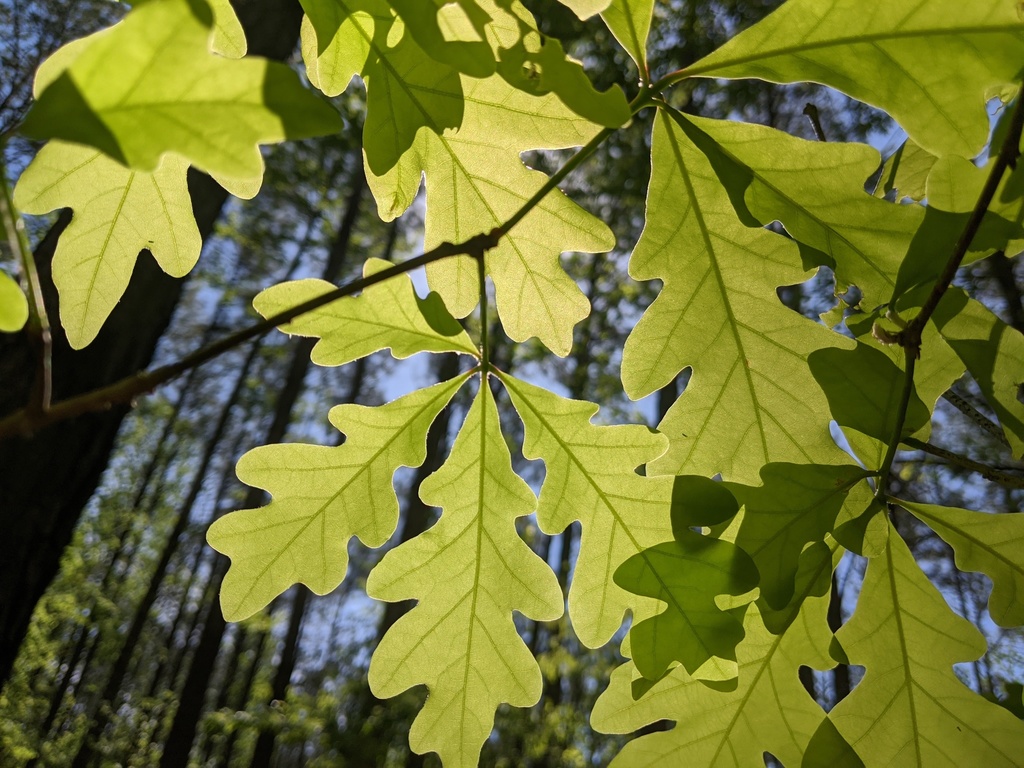
Overview
Oak bark is one of the strongest astringents in Western herbalism. It is valued for tightening and toning tissues that have become lax, boggy or worn down, from veins to gums to the lining of the gut. Traditionally it is also seen as a remedy of steadfast strength for people who have endured long hardship.
Parts used
Bark.
Actions
Astringent · Tonic · Antiseptic · Anti-inflammatory · Hemostatic · Antidiarrheal
Affinities
Mucosa · Veins · Teeth · Bone
Body systems
Cardiovascular · Digestive · Respiratory · Urinary · Musculoskeletal
Taste profile
Strongly astringent (the drying, puckering feel of strong tea).
Energetics
Cooling and very drying.
Tissue states
Relaxed · Damp
Traditional use
Quercus alba is the official North American species and Q. robur the European one, and many oaks have been used interchangeably. Following Matthew Wood, oak bark is a remedy for dark, knotted varicose veins and hemorrhoids; spongy, receding gums, loose teeth, bad breath and canker sores; sinus congestion with postnasal drip; strep throat, tonsillitis and swollen throat glands; exhaustion after bronchitis, with puffiness and discolouration under the eyes; indigestion, diarrhoea and a prolapsed or poorly toned bowel; bladder ulceration with blood in the urine; vaginitis; bleeding and bruising; and lymph swelling after glands are removed. Dr. Christopher taught its use for the teeth. Dr. Bach introduced oak as a flower essence for people who keep fighting against adversity without ever giving up. Rademacher, Burnett and Shepherd used Q. robur in the treatment of alcoholism, and older notes also list goitre and osteoporosis.
Current use
Germany's Commission E and Europe's EMA recognise oak bark for mild diarrhoea (taken internally), for mild inflammation of the mouth and throat (as a gargle), and for minor inflammatory skin conditions, anal itching and hemorrhoids (as washes, compresses and sitz baths, meaning a shallow hip bath). Its tannins bind to proteins on the surface of tissue, forming a tightened protective layer, which explains these uses.
Preparation
A decoction (simmered tea) of the dried bark is used as a gargle and mouthwash for gums and teeth, as a wash or compress for the skin, and as a sitz bath for hemorrhoids. A tincture (alcohol extract) is used in drops internally. The bark of young branches, harvested in spring, is preferred.
Dosage guidance
Oak is so strongly astringent that it is used in small doses: Matthew Wood favours 1 to 3 drops of tincture. EMA: for diarrhoea, about 1 g of bark as a decoction up to three times a day for no more than 3-4 days; as a gargle or wash, a decoction of about 20 g per litre of water.
Cautions & contraindications
Please don't use oak bark baths on large areas of broken skin, or on weeping eczema or large wounds, and avoid full baths if you have a fever, heart failure or high blood pressure (per EMA). Its tannins bind to proteins and minerals, so internally they can upset the stomach, cause constipation, and reduce the absorption of iron and of medicines; take it at least an hour apart from other medicines. Internal use is short-term only. Please see a doctor if diarrhoea lasts more than a few days or there is blood in the stool.
Evidence notes
From Winter's Herb101 notes (Assignments; Damp, Flowing, or Relaxed Tissue State; Tissue States), citing Wood, The Practice of Traditional Western Herbalism pp. 207-209, with references to Dr. Christopher and Dr. Bach.