Overview
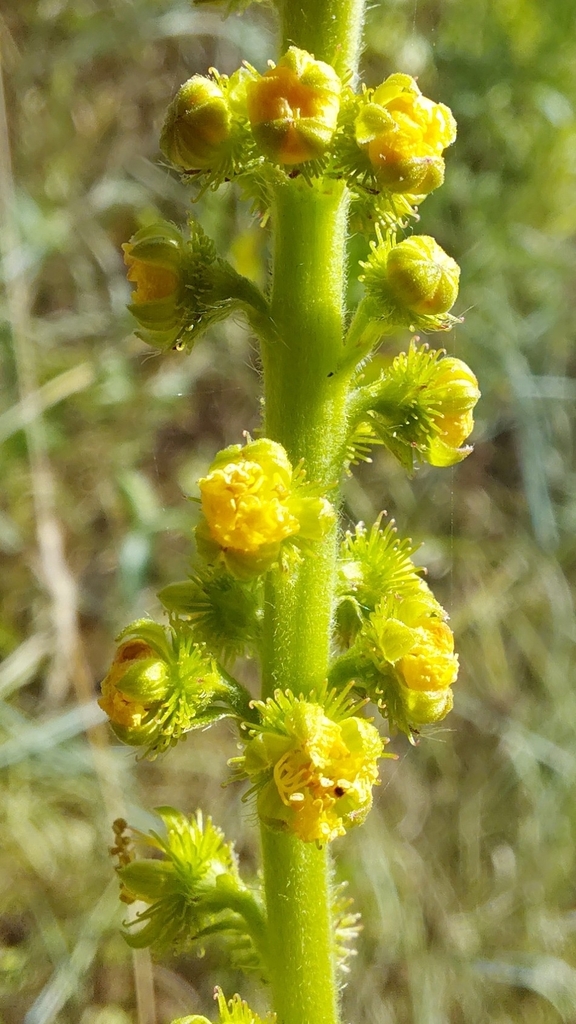
Agrimony is a slender, upright meadow plant with spikes of small yellow flowers, and it is one of the gentlest astringents in the herbal world (an astringent tightens and tones tissue). In my studies it stands out above all as a remedy for tension, especially the kind people hide behind a cheerful face. The herbalist Matthew Wood calls it the finest remedy he knows for tension, an idea that began with Dr. Edward Bach's flower essence work.
Parts used
Leaves and flowering tops (aerial parts), best gathered just before flowering.
Actions
Astringent · Relaxant · Nervine · Antispasmodic · Hepatic · Cholagogue · Diuretic · Vulnerary · Anti-inflammatory · Tonic · Bitter
Affinities
Nervous system · Gastrointestinal tract · Liver · Kidneys
Body systems
Nervous · Digestive · Urinary · Integumentary
Taste profile
Mild at first, then subtly sweet, sour and acrid (a sharp, slightly biting edge), resinous and lightly astringent.
Energetics
Neutral to slightly cooling; relaxing to tense tissue and toning to lax tissue.
Tissue states
Tense · Relaxed
Traditional use
In the tradition Wood records, agrimony was given to people who hold their breath against pain or hide anger and frustration behind a polished, 'tortured-ly cheerful' front, and to people who turn to alcohol, stimulants or risk-taking to push feelings down; work tension between employer and employee was a classic picture. It was used for digestion upset by tension (griping cramps, nausea, constipation alternating with diarrhea, loose fatty stools and poor fat digestion), mucus colitis, and to tone the bowel after food poisoning or dysentery. It was also used to support the liver, for pain while passing gall- or kidney stones, painful urinary infections, bed-wetting in anxious children and incontinence in the elderly, painful or heavy periods, tension headaches, mouth sores and ulcers, breath-holding coughs such as whooping cough and asthma, and stress-related welts, rashes and psoriasis.
Current use
Agrimony is used today mainly as a mild astringent: as a tea for mild, non-specific diarrhea, as a gargle for a sore mouth and throat, and on the skin for minor inflammation. European regulators (the EMA's herbal committee) recognise these traditional uses. Modern herbalists also value it as a relaxant for people whose stress shows up in the gut, liver, bladder or skin.
Preparation
The leaves and flowering tops are used, ideally gathered before flowering, when a slightly acrid resin is on the leaves; after flowering the plant becomes more astringent. It is prepared as an infusion (steeped like tea), as a tincture (an alcohol extract), as a gargle or wash, and as a flower essence. Wood favours the native American species, Agrimonia gryposepala, and pairs agrimony with true Solomon's seal (7 parts agrimony to 4 parts Solomon's seal) as an especially relaxing blend.
Dosage guidance
Wood works with tiny doses of 1 to 3 drops of tincture and notes that larger doses also work. Typical modern doses are 2 to 4 g of dried herb as a tea up to three times a day (EMA). Please seek advice before giving it to children, and see a practitioner if diarrhea lasts more than a few days.
Cautions & contraindications
Agrimony is generally considered safe in ordinary amounts. Because it is rich in tannins (the puckering compounds that tighten tissue), large or long-term doses can cause constipation and an upset stomach, and tannins can reduce the absorption of iron and some medicines if taken at the same time, so space them a couple of hours apart. Please avoid it during pregnancy and breastfeeding, where safety has not been established.
Evidence notes
From Winter's Herb101 notes, citing Wood, The Practice of Traditional Western Herbalism (pp. 162-164), with reference to Dr. Edward Bach.