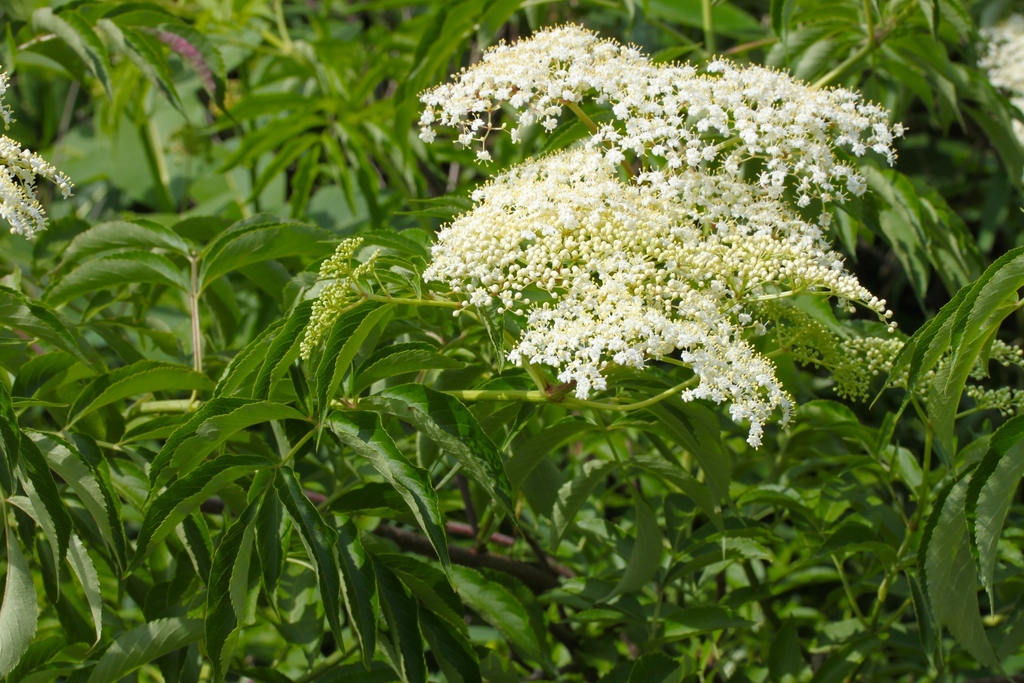
Overview
American elder is a fast-growing shrub native across the eastern and central United States, with flat clusters of creamy white flowers in early summer and drooping bunches of tiny dark purple berries in early autumn. Both the flowers and the cooked berries are prized as food and medicine, especially for colds, fevers and the changing seasons. It is the close North American cousin of European elder.
How it compares: American elder (Sambucus canadensis, now often classed as Sambucus nigra subsp. canadensis) and European elder (Sambucus nigra) are so closely related that many botanists treat them as one species, and herbal texts discuss them together because they share the same uses and the same key constituents: flavonoids such as rutin and quercetin in the flowers, and dark anthocyanin pigments in the berries. For traditional uses (elderflower tea to bring on a sweat in colds and fevers, cooked elderberry syrups, jams and wines) they can be used interchangeably. Where they differ is the evidence: almost all of the clinical research on elderberry for influenza used standardized European elder extracts (such as Sambucol), so if you want a product that matches the studies, European elder is the better-documented choice. American elder berries, a native shrub here in North America, are a fine and often more local choice for home syrups and food. The flowers of both are similarly diaphoretic and anti-catarrhal. Both carry the same cautions: the leaves, stems, bark, seeds and unripe or raw berries contain cyanogenic glycosides, so only ripe, cooked berries and the flowers are used internally. Neither should be confused with dwarf elder (Sambucus ebulus) or red-berried elder (Sambucus racemosa), which are more toxic and not used as food.
Plant family
Adoxaceae (also placed in Sambucaceae or Caprifoliaceae)
Parts used
Flower and ripe, cooked fruit internally; leaf externally only.
Actions
Diaphoretic · Anti-catarrhal · Anti-inflammatory · Antimicrobial · Antiviral · Alterative · Diuretic · Laxative · Refrigerant
Affinities
Respiratory system · Immune system · Skin
Body systems
Respiratory · Immune · Integumentary
Taste profile
Flower: sweetish and somewhat aromatic. Berry: sweet-tart.
Energetics
Flower: cooling and drying, opens the pores. Berry: cooling.
Traditional use
In folk medicine elder was used for coughs, sore throats, asthma and bronchitis, colds and fevers, headaches, rheumatism and gout, and externally for abrasions, bruises, burns, chafing, sores and swellings. The fruit goes into pies and cobblers (it can stand in for blackberries), the flowers become fritters, and both have long been made into wine. Dried berries improve in flavor and are a good source of vitamin C.
Current use
Elderflower is a diaphoretic, meaning it helps you sweat, and it is used as a hot tea during colds and fevers, classically blended with peppermint and yarrow. It is also anti-catarrhal (helps clear excess mucus). Cooked elderberry is made into syrups for coughs, colds and seasonal support. Laboratory studies show standardized elderberry extracts have activity against several upper-respiratory bacteria and against influenza viruses, and clinical trials with European elderberry extract found flu symptoms eased several days sooner; most of that research used European elder, though the two are chemically very similar. Elderflower water is also used in skin preparations and perfumery.
Preparation
Flowers: gather fresh, fully open flower clusters on a dry morning, shake out insects, and dry them on screens; the flowers are steeped as a hot infusion (a covered tea) for 10 to 15 minutes. Choose the flowers when you want to bring on a sweat in a fever or clear catarrh, since their flavonoids and volatile oil drive that diaphoretic, anti-catarrhal action. Berries: harvest only fully ripe, dark berries, strip them from the stems, and always cook them; simmer them into a decoction, then sweeten with honey for a syrup, or make jam or wine. Choose the berries for their anthocyanin-rich antiviral and antioxidant support and for food. A classic elderberry cough syrup combines the berries with horehound, licorice root, elecampane, hyssop and marshmallow root in a decoction, sweetened with honey. Elder can also be taken as a liquid extract. Leaves are used only externally in traditional ointments, never internally.
Dosage guidance
Dried flower: 2 to 4 g as an infusion, three times daily. Liquid extract (1:1 in 25% alcohol): 2 to 4 mL three times daily. Traditional fever blend (equal parts elderflower, peppermint and yarrow): 1 teaspoon per cup of boiling water, 4 to 8 tablespoons every two hours. Elderberry cough syrup: children 1 teaspoon up to 6 times a day, adults 1 teaspoon up to 12 times a day. Keep flowers and cooked fruit to food-like amounts.
Cautions & contraindications
Please avoid elder during pregnancy and breastfeeding, as its safety has not been established. Never eat raw or unripe berries, seeds, leaves, stems or bark. They contain cyanogenic glycosides (mainly sambunigrin): when the plant tissue is crushed or chewed, these release hydrogen cyanide, which blocks the enzyme cells use to make energy from oxygen (cytochrome c oxidase). Small exposures cause nausea, vomiting, diarrhea, dizziness and weakness; larger ones can be dangerous. Cooking ripe berries breaks these compounds down, which is why elderberries are always cooked and the seeds are best strained out. Drinking several glasses of elderberry juice has caused nausea, vomiting, weakness, dizziness and numbness. American elder may inhibit the liver enzyme CYP3A4, which breaks down many medicines (such as some statins, antifungals and sedatives), so use it cautiously or avoid it if you take those. Because elderberry stimulates immune activity, people with autoimmune conditions or on immunosuppressant drugs should check with their provider. Do not confuse it with dwarf elder (Sambucus ebulus).
Evidence notes
From Winter's HERB304 notes (monograph M5 P-T), citing Duke, Handbook of Medicinal Herbs; Barnes et al., Herbal Medicines; Zakay-Rones et al. (1995); Krawitz et al. (2011); and the AHPA Botanical Safety Handbook.