Overview
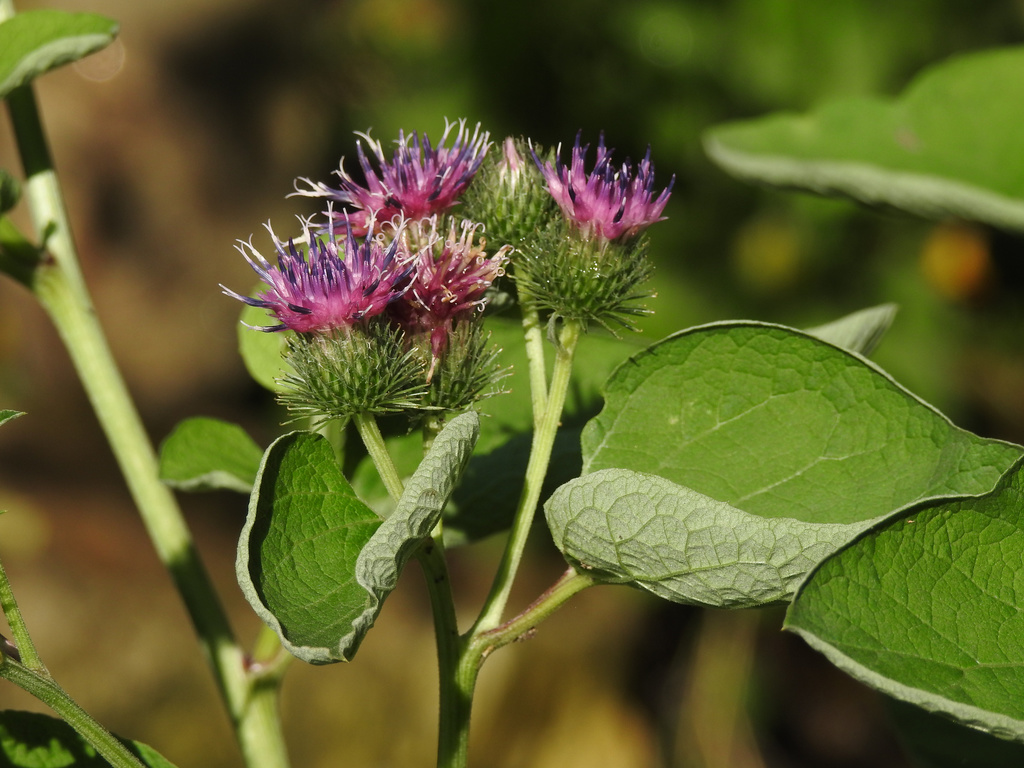
Burdock, also known as gobo, is a tenacious biennial weed with sticky burrs and a long, oily taproot, and it is counted among the great cleansing and nourishing herbs. It is used to support the liver, skin and lymph, especially for people who run dry, thin and worn out. It is pleasant tasting and gentle, and is often taken over a long stretch as a slow, building tonic.
Plant family
Asteraceae
Parts used
Mainly the root (for chronic conditions); the seed (for acute conditions); leaves externally as poultices and salves.
Actions
Alterative · Nutritive · Bitter · Diuretic · Cholagogue · Diaphoretic · Lymphatic · Antimicrobial · Hypoglycemic · Aperient
Affinities
Liver · Gall bladder · Kidneys · Skin · Lymph · Endocrine system
Body systems
Digestive · Integumentary · Lymphatic · Urinary · Endocrine · Respiratory · Musculoskeletal
Taste profile
The root tastes sweet, bitter, slightly pungent and oily, with a woody, mucilaginous aroma. The seed is bitter, pungent, sweet and diffusive, meaning its effect spreads outward through the body.
Energetics
Warming and oily (per Matthew Wood); Rosemary Gladstar describes it as cooling to the liver and to hot, agitated states.
Tissue states
Dry · Atrophy · Damp · Stagnant
Traditional use
Burdock has long been ranked among the front-line 'blood purifiers' (alteratives, meaning herbs that gradually help the body clear and renew itself), and herbalist Matthew Wood also counts it a nourishing tonic for the body's oils. It is an old remedy for kidney stones, gout and gravel. The root is part of the Native American-associated formula Essiac. The leaves were laid on as poultices for boils, rashes, poison ivy, measles and itchy skin. In Chinese medicine the seed (niu bang zi) is used for sore, swollen throats with fever, for helping a measles rash come out fully, and for boils and mumps. In Japan the root is eaten as a vegetable.
Current use
Burdock root can be useful for skin troubles such as dry or scaly skin, acne, boils, eczema and psoriasis, taken inside and used as a wash; it is a classic part of psoriasis blends with cleavers, sarsaparilla and yellow dock taken over months. It is also used for sluggish bile flow, dry stools, and a congested liver or gallbladder; for swollen lymph glands; for steadier blood sugar (the root is rich in inulin, a prebiotic fiber, and has shown antidiabetic effects in animal studies); for dry sinuses and airways; and for stiff, achy joints that feel better once you get moving. It is a lovely herb for teens with hormonal skin and for 'hot' liver-stress patterns, the red-faced, quick-tempered, overheated kind. The seed is used for acute, feverish throat and skin conditions (see preparation).
Preparation
Root: the root is dug in autumn of the first year or spring of the second, before the plant sends up its flower stalk. It is so oily that it goes rancid easily, so it's best to dry it with gentle artificial heat in an airy place. The dried root is simmered into a decoction (a tea simmered from roots) or made into a tincture (brandy extracts it beautifully). A decocted-root wash or bath soothes dry, itchy skin. A 'root beer' tea with ginger, cinnamon and a little stevia, mixed with sparkling water, makes it friendly for teens. In my studies, an infusion of the dried root tasted sweet, cooling and moistening, and it blends well with linden and oats for a nourishing, hydrating tea.
Seed: the seed is gathered at the end of the second year, as the plant is dying back, and is decocted or tinctured. Choose the seed for acute, hot, short-lived conditions: a sore throat with fever, a rash that won't come out, boils, or poor secretion in the upper digestive tract. Choose the root for chronic, long-term needs: dry skin, sluggish liver and bile, constipation, lymph congestion and slow rebuilding. The seed is more bitter, pungent and 'diffusive' (spreading outward to the surface), which is why it suits acute fevers and eruptions, while the oily, sweet root nourishes over time.
Leaf: used externally as a poultice or in salves for boils, rashes and itchy skin.
Dosage guidance
Following Rosemary Gladstar: a tincture of equal parts burdock and dandelion root, 1 teaspoon 2-3 times a day for 4-6 weeks; for swollen glands, 3-4 cups of burdock tea a day (about a quart). Following Matthew Wood, small to large doses may be given over a long time as a building tonic. Common references give 2-6 g dried root a day as a decoction. In Chinese medicine the seed is typically 6-12 g a day in decoction, with a practitioner.
Cautions & contraindications
Rosemary Gladstar lists no safety concerns and calls burdock one of the safest and most widely used herbs. A few sensible cautions: people allergic to the daisy family (Asteraceae) may react to it; because it may lower blood sugar, please monitor carefully if you take diabetes medicine; and because it is mildly diuretic, use care alongside diuretic drugs. Please buy from a trusted supplier: there are old reports of commercial 'burdock' tea contaminated with belladonna root, which caused atropine poisoning. As a precaution, please avoid medicinal amounts in pregnancy without guidance (my studies list it as balancing and nutritive in pregnancy traditionally, but modern safety data are limited).
Evidence notes
From Winter's Herb101 notes (Damp - Stagnation or Torpor; Tissue States), citing Matthew Wood, The Practice of Traditional Western Herbalism (pp. 224-227) and Rosemary Gladstar, Medicinal Herbs: A Beginner's Guide (pp. 107-111); plus HERB202 and HERB302 monograph pages (family, images).