Overview
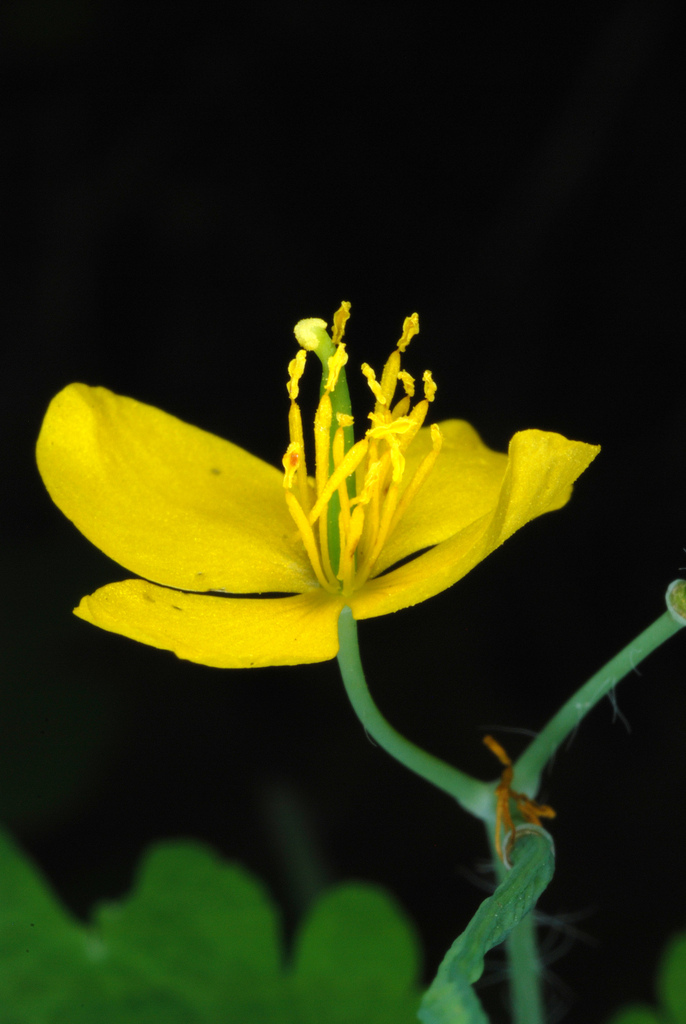
Greater celandine is a bright yellow-flowered relative of the poppy with a striking orange sap. It has a long history as a liver and gallbladder herb, but I want to be honest with you: it is a genuinely toxic plant with a very narrow safety margin. I honor it for its history and chemistry rather than recommend it for home use.
Plant family
Papaveraceae
Parts used
Aerial parts, sap (latex), root.
Actions
Antispasmodic · Cholagogue · Choleretic · Hepatic · Bitter · Antiviral
Affinities
Liver · Gallbladder · Skin
Body systems
Digestive · Integumentary
Taste profile
Bitter and acrid.
Energetics
Bitter, cooling and drying.
Traditional use
Traditionally it was used to support the liver and gallbladder, for gallbladder colic and sluggish bile, for spasm in the digestive tract, and as an old eye remedy (now known to be unsafe). The fresh orange sap was dabbed onto warts and corns. It was given only in 'drop doses', counted out drop by drop, because of its low therapeutic margin.
Current use
Today it is mainly of historical and practitioner interest. In my studies it is described as a hepatic (liver) herb with both cholagogue action (helping the gallbladder release bile) and choleretic action (helping the liver make more bile), plus antispasmodic effects on the bile ducts. Its main constituents are isoquinoline alkaloids: chelidonine, sanguinarine, berberine, coptisine and others. Because of documented liver injury, European regulators did not adopt a monograph, and internal use is discouraged; in folk practice its sap is still dabbed on warts.
Preparation
Historically the fresh sap was applied externally to warts, and the dried aerial parts were used in practitioner tinctures given in drop doses. Working with the dried plant is considered safer than the fresh. Please handle it with gloves: the fresh juice can blister skin.
Dosage guidance
Not for home internal use. If used at all, it is only under a qualified practitioner, in prescribed drop doses, and never if you have any liver concern.
Cautions & contraindications
Please be careful with this plant: the whole plant is poisonous, and large doses are toxic. The fresh sap is strongly irritating, can blister the skin and cause allergic reactions, so wear gloves and keep it well away from your eyes. Greater celandine has been linked to dozens of cases of liver injury (hepatitis), usually about a month after starting it and more often in women. The injury is considered idiosyncratic, meaning an unpredictable reaction in susceptible people rather than a simple overdose, and the exact compound responsible has not been pinned down, which is why no dose can be called safe. It also contains berberine, which can push bilirubin off its carrier protein in the blood; in newborns that free bilirubin can reach the brain, which is one reason it is never for pregnancy, breastfeeding or babies. Please avoid it entirely with any liver condition, in pregnancy and breastfeeding, and in children under 12. Large amounts can cause drowsiness, stomach irritation, vomiting and difficulty breathing. It is a different plant from lesser celandine (Ficaria verna), a buttercup with its own irritant toxins.
Evidence notes
Winter's HERB303 (Antiseptic & Hepatic Herbs) page holds only the course template (name, Latin, family).
Web-sourced seed pending Winter's review. Sources: Plants For A Future (https://pfaf.org/user/Plant.aspx?LatinName=Chelidonium+majus); EMA/HMPC Chelidonii herba (https://www.ema.europa.eu/en/medicines/herbal/chelidonii-herba)