Overview
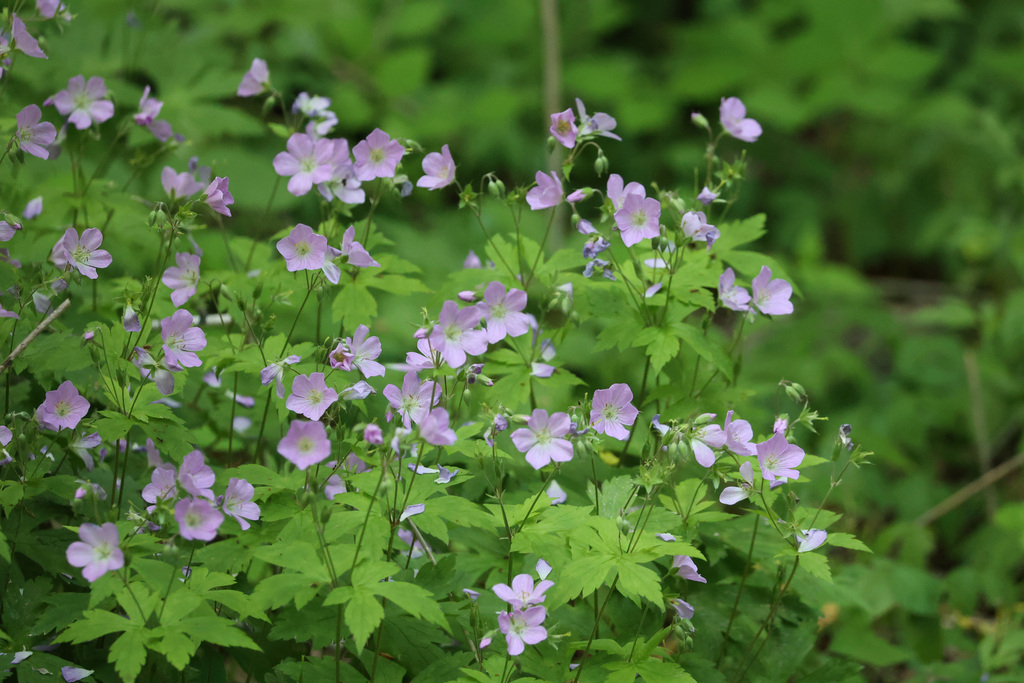
Cranesbill, or wild geranium, is a woodland wildflower with soft pink-purple blooms and a beak-shaped seed pod that gives it its name. Its root is rich in tannins, natural compounds that tighten and tone tissue, which make it one of the classic astringent herbs. Cranesbill is used where tissues are loose, leaky or bleeding.
Plant family
Geraniaceae
Parts used
Root (rhizome) mainly; the leaves and aerial parts are used as a milder astringent.
Actions
Astringent · Styptic · Hemostatic · Antidiarrheal · Anti-inflammatory · Vulnerary · Antiseptic · Tonic
Affinities
Gut · Mucous membranes · Skin
Body systems
Digestive · Integumentary
Taste profile
Strongly astringent (puckering and drying) and slightly bitter.
Energetics
Cooling and drying.
Tissue states
Damp · Relaxed
Traditional use
Native American peoples and later the Eclectic physicians used the root for diarrhea and dysentery, as a gargle for sore mouth, gums and throat and for thrush, as a douche for vaginal discharge, to ease heavy menstrual bleeding and bleeding between periods, and as a powdered root sprinkled on small wounds to stop bleeding (a styptic). It was also used for weak, relaxed tissue such as hemorrhoids.
Current use
Cranesbill is used as an astringent (tightening and toning tissue) to support the lining of the gut in loose stools and diarrhea, as a mouth rinse or gargle for sore gums, mouth sores and sore throats, and externally as a wash or powder for minor cuts and weepy skin. Hoffmann pairs it with marshmallow and calendula for inflammation and ulceration of the stomach and duodenum. Its effects come mainly from its high tannin content (often cited at 10 to 20% in the root), with gallic and ellagic acids.
Preparation
The root (rhizome) is the main medicinal part, dug in late summer or autumn when its tannins are highest, then dried. Being dense and woody, it is prepared as a decoction: simmer 1 to 2 teaspoons of dried root in a cup of water for 10 to 15 minutes. The cooled decoction makes a mouth rinse, gargle or external wash, and the finely powdered root can be dusted onto minor cuts. The leaves and aerial parts are milder and are steeped as an infusion (a tea poured over with hot water) where a gentler astringent is wanted. A tincture of the root is also used.
Dosage guidance
Dried root: 1 to 2 g, or a decoction of 1 to 2 teaspoons per cup, three times daily. Tincture (1:5): 2 to 4 mL three times daily. Use short term.
Cautions & contraindications
No serious hazards are recorded, but its high tannin content can upset a sensitive stomach and, taken alongside food or supplements, can reduce iron absorption, because tannins bind to iron and other minerals in the gut. Tannins can also bind to medicines, so take cranesbill at least 2 hours apart from them. Diarrhea that lasts more than a few days, blood in the stool, or any unexplained bleeding needs a medical check. There is not enough safety information for use in pregnancy or breastfeeding.
Evidence notes
HERB302 astringent-herbs page holds only name and family.
Web-sourced seed pending Winter's review. Sources: Plants For A Future (https://pfaf.org/user/Plant.aspx?LatinName=Geranium+maculatum); Lady Bird Johnson Wildflower Center (https://www.wildflower.org/plants/result.php?id_plant=GEMA)