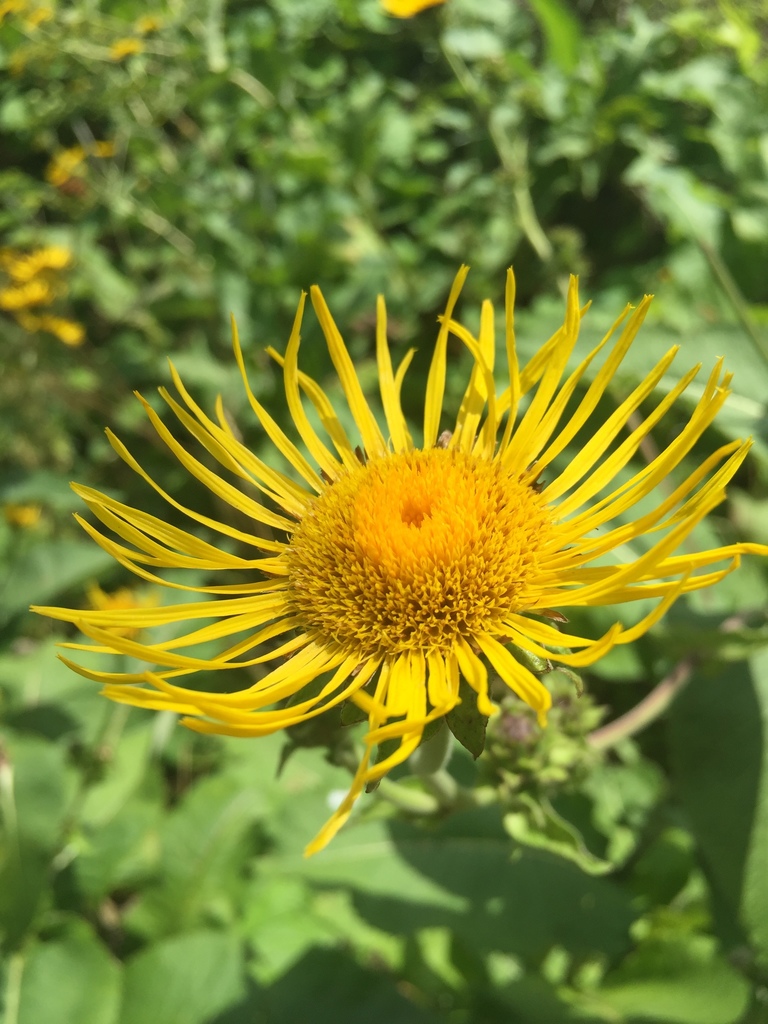
Overview
Elecampane is a tall, sunny member of the daisy family with big yellow flowers and an aromatic, camphor-scented root. Its root is a warming lung remedy for stubborn, wet coughs and a bitter tonic that wakes up digestion. It is one of the few herbs specific to both the respiratory and digestive systems, which makes it especially useful when the two are tangled together.
Plant family
Asteraceae
Parts used
Root and rootstock, from plants at least 2 years old.
Actions
Expectorant · Antimicrobial · Antiseptic · Antispasmodic · Carminative · Tonic · Diaphoretic · Alterative · Anthelmintic · Antitussive · Cholagogue · Stomachic · Bitter
Affinities
Lungs and bronchial passages · Digestive tract · Liver
Body systems
Respiratory · Digestive
Taste profile
Acrid, bitter and pungent, with an aromatic, camphor-like scent and a sweetish note from its inulin.
Energetics
Warming and drying.
Traditional use
The herbalist Gerard praised it for shortness of breath and old coughs, especially for people who must hold their necks upright to breathe. It was traditionally used for asthma, bronchitis, whooping cough, cystitis, water retention, delayed menstruation, gastritis and loss of appetite, and applied outwardly for nerve pain and sciatica. Candied elecampane root was once a popular cough sweet. Combined with wormwood, it was a traditional remedy for intestinal worms.
Current use
Elecampane is used as a stimulating expectorant (it helps you cough up thick, stuck mucus) for chronic coughs, bronchitis and the lingering cough after a chest cold, usually blended with other expectorants and soothing demulcent herbs; adding echinacea strengthens the formula's antiseptic action. It suits a cough that comes with poor digestion, and, paired with horehound, sinus congestion where postnasal drip upsets the stomach. As a bitter it is used for sluggish digestion, poor appetite and a congested liver. Its sesquiterpene lactones (alantolactone and isoalantolactone) show antibacterial and antifungal activity in laboratory studies, including against the tuberculosis bacterium, and alantolactone has been used against intestinal worms. Externally, the decoction is used as a wash or gargle for inflamed gums, wounds and skin complaints.
Preparation
The root is dug in autumn from plants at least 2 years old, when its inulin content is highest; older roots become woody and stringy. For the lungs it is used as a decoction (simmer the chopped root 10 to 15 minutes), a fluid extract or a tincture. Its key bitter constituent, helenin (elecampane camphor), dissolves better in alcohol than in water, so a tincture captures more of it, while a decoction or cold infusion draws out more of the soothing inulin. The decoction also makes a gargle for inflamed gums and a wash for wounds and skin; the powdered root mixed into a paste is applied externally; and it is prepared as an infusion with wormwood for worms. Elecampane is a classic ingredient in elderberry cough syrups.
Dosage guidance
Dried root: 1.5 to 4 g as a decoction three times daily. Tincture (1:5 in 40% alcohol): 1 to 5 mL three times daily. Large doses can cause vomiting, so stay within normal amounts.
Cautions & contraindications
Please don't use elecampane while breastfeeding. It contains sesquiterpene lactones (especially alantolactone), which are strong contact allergens: they bind to proteins in the skin and trigger an immune reaction, so it may cause contact dermatitis, and anyone allergic to the daisy family (Asteraceae) should avoid it. For the same reason elecampane essential oil is a severe skin sensitizer and is not permitted as a fragrance ingredient in the EU. It may interfere with blood-sugar-lowering and blood-pressure medications. Large doses can cause vomiting, diarrhea, cramps and, rarely, paralysis-like symptoms. It may add to the effects of sedative herbs, supplements and medications. Avoid in pregnancy except under professional guidance.
Evidence notes
From Winter's HERB303 notes (monograph page and HERB303 textbook summary), quoting Gerard.