Overview
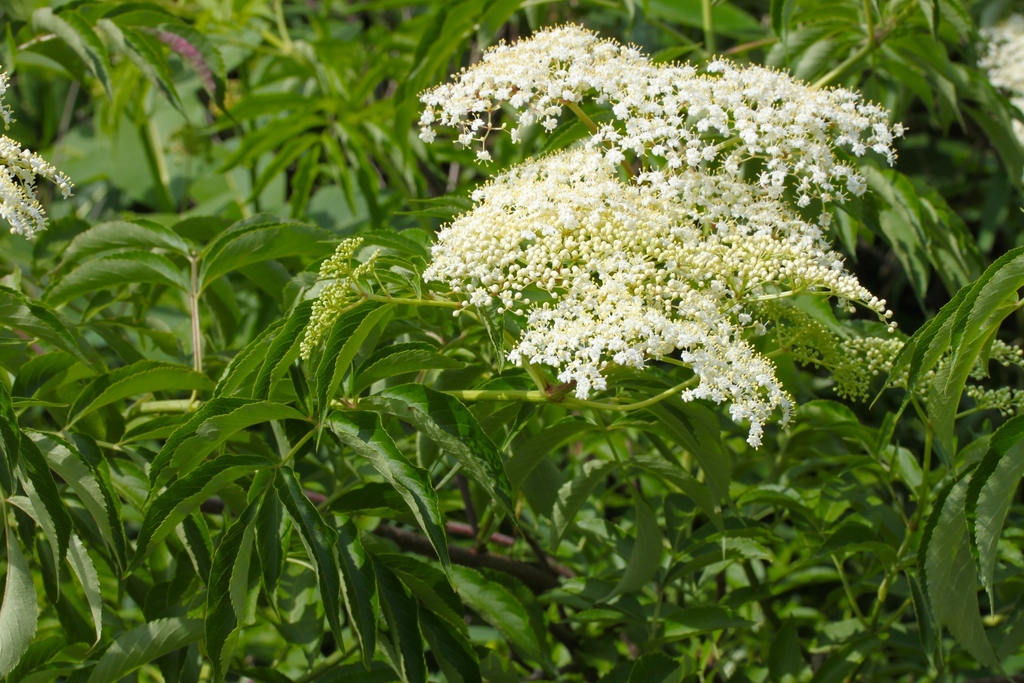
European elder is a tall shrub or small tree, long called 'the medicine chest of country people.' Its flat clusters of creamy, muscat-scented flowers and its black-purple berries are among the best-loved remedies for colds, flu and stuffy sinuses, and the berries also go into syrups, wines and preserves. It is the elder behind most of the modern clinical research.
How it compares: American elder (Sambucus canadensis, now often classed as Sambucus nigra subsp. canadensis) and European elder (Sambucus nigra) are so closely related that many botanists treat them as one species, and herbal texts discuss them together because they share the same uses and the same key constituents: flavonoids such as rutin and quercetin in the flowers, and dark anthocyanin pigments in the berries. For traditional uses (elderflower tea to bring on a sweat in colds and fevers, cooked elderberry syrups, jams and wines) they can be used interchangeably. Where they differ is the evidence: almost all of the clinical research on elderberry for influenza used standardized European elder extracts (such as Sambucol), so if you want a product that matches the studies, European elder is the better-documented choice. American elder berries, a native shrub here in North America, are a fine and often more local choice for home syrups and food. The flowers of both are similarly diaphoretic and anti-catarrhal. Both carry the same cautions: the leaves, stems, bark, seeds and unripe or raw berries contain cyanogenic glycosides, so only ripe, cooked berries and the flowers are used internally. Neither should be confused with dwarf elder (Sambucus ebulus) or red-berried elder (Sambucus racemosa), which are more toxic and not used as food.
Plant family
Sambucaceae (or Caprifoliaceae)
Parts used
Flower and ripe, cooked berry internally; leaf and inner bark externally only.
Actions
Diaphoretic · Anti-catarrhal · Diuretic · Expectorant · Laxative · Anti-inflammatory · Antioxidant · Antiviral · Immunomodulator · Emollient · Alterative · Febrifuge
Affinities
Upper respiratory tract · Sinuses · Chest · Eyes · Skin
Body systems
Respiratory · Immune · Urinary · Digestive · Integumentary
Taste profile
Flower: sweet and lightly mucilaginous with a muscat scent. Berry: sweet-tart.
Energetics
Flower: cooling and drying, opens the pores. Berry: cooling.
Traditional use
Traditionally elder was used for colds, influenza, chronic nasal catarrh with blocked ears, and sinusitis. Elderflower tea was taken for chest complaints, as a spring tonic and blood cleanser, and as an eyewash for inflamed eyes, and flower poultices were laid on painful swellings. Tea of the dried berries was used for colic and diarrhea. The bark and leaves were used as strong purgatives and diuretics (no longer recommended because of their toxicity), and an ointment of the green inner bark or leaves was used to soften the skin and on bruises, sprains and chilblains.
Current use
Elderberry syrup is widely used to support the body during flu season. In controlled trials, a standardized European elderberry extract relieved influenza symptoms around four days sooner than placebo, and laboratory work shows its flavonoids and anthocyanins can block influenza viruses from attaching to and entering cells. The berries' anthocyanins are also antioxidant and appear to modulate the immune response. Elderflower is a diaphoretic (helps you sweat) and anti-catarrhal (clears excess mucus), used as a hot tea in colds, fevers, sinus congestion and hay-fever-type catarrh; the European Medicines Agency recognizes elderflower as a traditional remedy for early cold symptoms.
Preparation
Flowers: harvested fresh in full bloom and dried; steeped as a hot infusion, covered, for 10 to 15 minutes, or made into a tincture. Choose the flowers to bring on a sweat in a fever and to clear catarrh (their flavonoids and volatile oil), often blended with peppermint, yarrow or hyssop for colds, and with boneset and peppermint for flu. Berries: only fully ripe, cooked berries are used; boil the juice or berries briefly and make a syrup, jam or wine, or simmer dried berries into a tea. Choose the berries for flu-season antiviral and antioxidant support (their anthocyanins). Leaves and inner bark: traditional external ointments only. Flower poultices and washes are used externally for inflamed eyes and skin.
Dosage guidance
For adults with flu: 15 mL (1 tablespoon) of an elderberry juice syrup four times daily for 3 to 5 days. For children: 15 mL twice daily for three days. Dried flower: 2 to 5 g as an infusion up to three times daily.
Cautions & contraindications
Please avoid elder during pregnancy and breastfeeding, as its safety has not been established. Never eat raw or unripe berries, seeds, leaves, stems or bark. They contain cyanogenic glycosides (mainly sambunigrin): when the plant tissue is crushed or chewed, these release hydrogen cyanide, which blocks the enzyme cells use to make energy from oxygen (cytochrome c oxidase). Small exposures cause nausea, vomiting, diarrhea, dizziness and weakness; larger ones can be dangerous. Cooking ripe berries breaks these compounds down, which is why elderberries are always cooked and the seeds are best strained out. The bark also contains ribosome-inactivating proteins (lectins related to ricin, though far less toxic), another reason it is not taken internally. Elder may lower blood sugar, so monitor glucose if you take diabetes medication. Use it with care alongside diuretics or laxatives. People with autoimmune conditions or on immunosuppressants should check with their provider first.
Evidence notes
From Winter's HERB304 notes, citing Barnes, Anderson & Phillipson, Herbal Medicines; Grieve, A Modern Herbal; Chiej, Encyclopaedia of Medicinal Plants; Bown, Encyclopaedia of Herbs; AHPA Botanical Safety Handbook (Class 1); and Zakay-Rones et al. influenza studies.