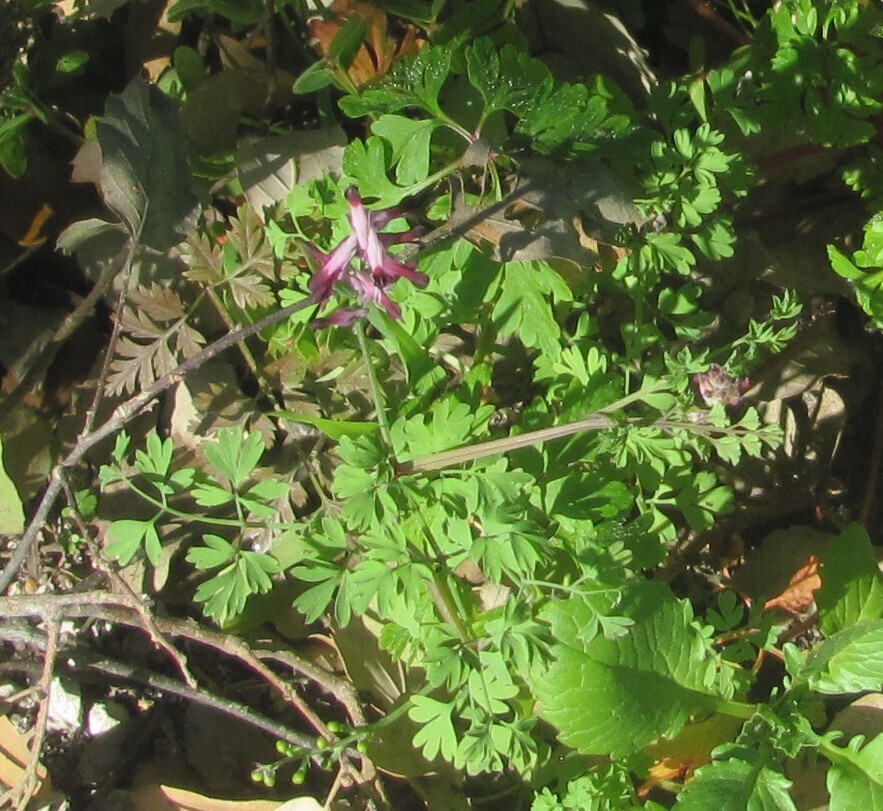
Overview
Fumitory is a delicate, smoky-grey field weed with little pink flowers, whose name means 'smoke of the earth'. It has a long European history as a gentle bitter for the liver and gallbladder, and as a cleansing herb for troubled skin. It is recognized in Europe for easing that heavy, too-full feeling after meals.
Plant family
Fumariaceae
Parts used
Flowering aerial parts (the parts above ground).
Actions
Cholagogue · Amphicholeretic · Bitter · Alterative · Antispasmodic · Diuretic · Laxative · Hepatic
Affinities
Liver · Gallbladder · Skin
Body systems
Digestive · Integumentary
Taste profile
Bitter and slightly salty.
Energetics
Cooling and drying.
Traditional use
Traditionally fumitory was used to support the liver and gallbladder, as a mild laxative and diuretic (helping you pass water), and as an alterative or 'blood purifier' for the skin in eczema, acne and other eruptions, both taken and applied. A wash was used for cradle cap. In traditional Western herbalism it is grouped among the gentler, non-bitter alteratives for a stagnant, sluggish system.
Current use
Fumitory is recognized in the EU as a traditional herbal medicine for digestive discomfort such as fullness, slow digestion and wind, linked to the liver and gallbladder. It is described as amphicholeretic, meaning it helps balance bile flow, increasing it when it is low and calming it when excessive. I would use it before meals for this kind of sluggish, over-full digestion.
Preparation
An infusion (tea) of the dried flowering herb, a tincture, a liquid or dry extract, or the fresh plant juice, taken before meals. A cold extract (the herb steeped in cool water) is also used.
Dosage guidance
Per the EU monograph, for adults: a tea of about 2 g dried herb in 250 mL boiling water, up to 4.8-6.4 g a day split into 3-4 doses; or tincture 0.5-1 mL per dose, 1-4 mL a day. Traditionally it is taken in short courses with breaks (my course notes describe up to about 8 days, then a break of 10 days or more). Please see a practitioner if your symptoms last beyond 2 weeks.
Cautions & contraindications
Please avoid fumitory if you are allergic to it. It is not recommended if you have blocked bile ducts, cholangitis (inflamed bile ducts), gallstones, liver disease or other gallbladder problems, since it may stimulate bile flow. Avoid it during pregnancy and breastfeeding (safety not established), and if you have epilepsy or glaucoma. The tea is not recommended under age 12, and extracts and tinctures not under age 18. Fumitory contains isoquinoline alkaloids such as protopine, which act on the heart and nervous system in larger amounts; this is why high or prolonged doses may cause drowsiness and why it may add to the effect of blood-pressure medicines.
Evidence notes
Winter's HERB303 page holds only the course template; no herb content. Web-sourced seed pending Winter's review. Sources: Plants For A Future (https://pfaf.org/user/Plant.aspx?LatinName=Fumaria+officinalis); European Medicines Agency, EU herbal monograph on Fumaria officinalis herba (https://www.ema.europa.eu/en/documents/herbal-monograph/final-european-union-herbal-monograph-fumaria-officinalis-l-herba-revision-1_en.pdf)