Overview
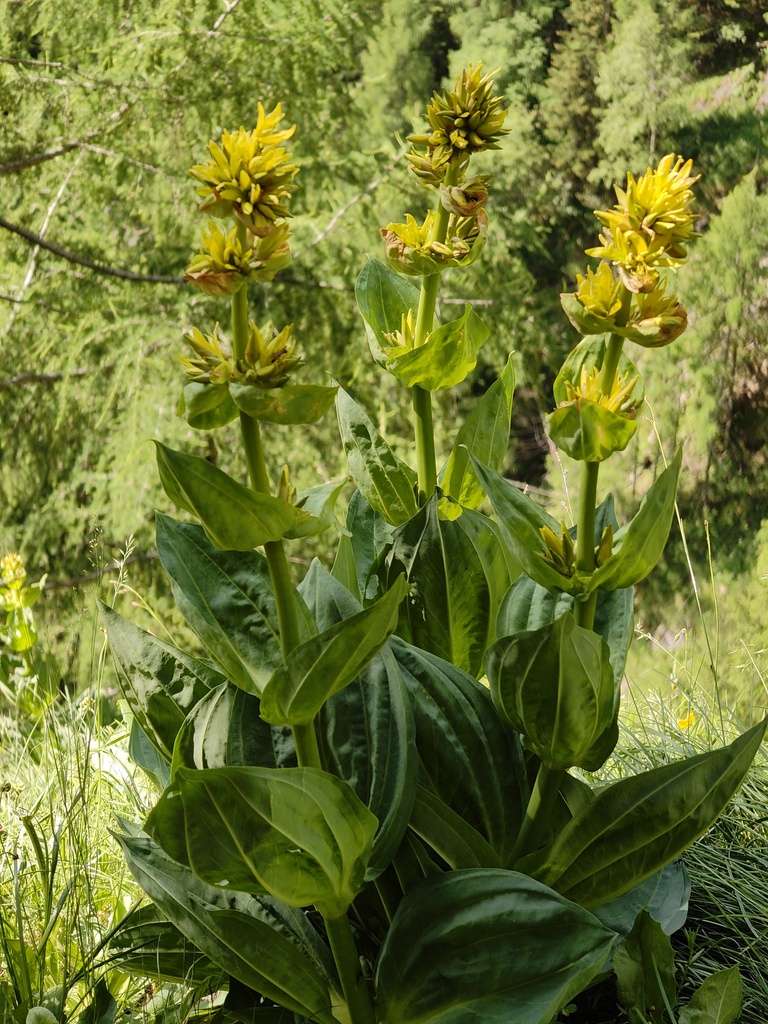
Great yellow gentian is a tall mountain perennial from Europe whose root is famous as one of the most bitter substances in nature. It is intensely bitter, to put it mildly, and hard to take as a tea, but it is very effective for waking up weak, sluggish digestion. That is why it sits at the heart of classic bitters and aperitifs.
Plant family
Gentianaceae
Parts used
Root and rhizome.
Actions
Bitter · Tonic · Cholagogue · Sialagogue · Stomachic · Hepatic · Febrifuge · Anti-inflammatory
Affinities
Stomach · Liver
Body systems
Digestive
Taste profile
Intensely bitter, with a faint sweetish aftertaste.
Energetics
Cooling and drying.
Tissue states
Hot
Traditional use
Gentian has traditionally been used to support sluggish digestion, poor appetite and the liver, as a general strengthening tonic, and for fevers. Energetically it is described as clearing excess heat and damp stagnation from the digestive system and liver with a downward, draining action. Because it is so cold and drying, herbalists have long paired it with warming herbs such as ginger, cardamom or orange peel for people who run cold or are depleted.
Current use
Gentian is used as a digestive bitter before meals to stimulate appetite and support weak, sluggish digestion, fullness and wind. Its bitterness triggers saliva, stomach acid, bile and digestive enzyme secretions, which is why Commission E recognizes it for loss of appetite and indigestion. As a tonic, it is valued during recovery from illness once the acute stage has passed, to rebuild appetite and strength.
Preparation
The dried root is used in small amounts as a tincture or bitters, a few drops on the tongue 15 to 30 minutes before meals, or as a small cold infusion (steeped in cool water) or a brief hot infusion. Tasting the bitterness is part of how it works, so capsules are less effective. It blends well with warming carminatives to make it easier to take and to balance its cold nature.
Dosage guidance
Commission E: 2 to 4 g of root daily, or 1 to 3 g of tincture daily, taken about 30 minutes before meals; a small cup of infusion made from 1 to 2 g of root. Start with less; a little goes a long way.
Cautions & contraindications
Please avoid gentian if you have a stomach or duodenal ulcer, gastritis or acid reflux, since it increases stomach acid. It may cause headache, nausea or vomiting in sensitive people or at high doses. There isn't enough safety data for pregnancy and breastfeeding. Wild gentian is protected in parts of Europe, so please choose cultivated root.
Evidence notes
HERB303 tonics-module page holds only name and family.
Web-sourced seed pending Winter's review. Sources: Plants For A Future (https://pfaf.org/user/Plant.aspx?LatinName=Gentiana+lutea); Wikipedia: Gentiana lutea (https://en.wikipedia.org/wiki/Gentiana_lutea)